Dr. Jack Bayramyan

Your Dental Practice and your Team: 3 Secrets to Cultivating the Ideal Team Player

Are you struggling with creating and keeping together healthy teams within your dental practice? Do you find that the same issues keep coming up again and again? Is the productivity within your teams not as high as it could be? Finally, could your team members use a boost of confidence, enthusiasm, focus, productivity or maybe all of the above? I’ve got just the book for you!  

Within the realms of leadership and teamwork in organizations, identifying individuals who possess the qualities necessary to thrive in a team setting is crucial. In 2016, Patrick Lencioni wrote, The Ideal Team Player: How to Recognize and Cultivate the Three Essential Virtues. This book will lend you the very solutions you need to solve these issues. Patrick Lencioni is arguably one of the world’s leading experts on healthy organization building and team cohesion.

What A Lack of Cohesive Team Structure Means for Your Dental Practice 

However, before we delve into Patrick Lencioni’s essential work, let’s look at why teamwork is vital to the success of your dental practice. First, let me say, you’re not alone. Lencioni wrote this book because the issues and obstacles faced by teams within organizations are universal and ubiquitous. And solving them is no small feat. Hopefully, this post will offer some real solutions for you and your dental practice. 

Teamwork within any organization is pivotal and determinant to the success of that organization. I cannot be any clearer than that. So, what are some common problems associated with weak or non-existent teamwork?   

Lack of Communication

  • Poor teamwork often results in inadequate communication among team members. When there is a lack of effective communication, crucial information may not be shared, leading to misunderstandings, errors, and delays in decision-making. It can also create a fragmented work environment where employees feel disconnected and isolated without proper problem-solving mechanisms or processes at their disposal.  

Low Productivity

  • Weak or non-existent teamwork can significantly hinder productivity. When team members are unable to collaborate efficiently, tasks take longer to complete, and the overall workflow becomes inefficient. Without proper coordination, standardized processes and support from one another, individuals may struggle to meet deadlines and achieve their goals. 

Increased Conflicts and Tension

  • Poor teamwork can contribute to heightened conflicts and tension among team members. When individuals do not work well together or lack the necessary communication skills, disagreements can escalate, and relationships may become strained. This can create a toxic work environment, hampering morale and job satisfaction within your dental practice. 

Lack of Innovation and Creativity

  • Teamwork is essential for fostering innovation and creativity. When collaboration is weak, opportunities for brainstorming, sharing ideas, and leveraging diverse perspectives diminish. Without a collaborative environment that encourages innovation, organizations may miss out on valuable insights and potential breakthroughs. 

Decreased Employee Engagement

  • A lack of teamwork can lead to decreased employee engagement and motivation. When individuals feel isolated or unsupported by their team, they are less likely to feel connected to their work and the organization as a whole. This can result in decreased job satisfaction, higher turnover rates, and reduced overall performance. 

Missed Opportunities for Learning and Development

  • Strong teamwork provides an environment that promotes learning and development. When teamwork is weak, individuals may miss out on valuable opportunities to learn from their peers, share knowledge, and grow together. This can hinder individual and collective growth within the organization. 

Reduced Patient Satisfaction

  • Collaboration and effective teamwork are crucial for delivering high-quality services for your patients. Weak teamwork can lead to miscommunication, errors, and a lack of coordination, all of which can negatively impact patients’ experience in your dental practice. Without a cohesive team working together, meeting patient needs becomes challenging. 

Improving communication, fostering a collaborative culture, and providing the necessary support and resources for teams to succeed is your job as the leader of your organization. So, how do you recognize and fix the issues associated with weak teamwork thereby building stronger teams and enhancing overall performance and success?  

Elevating Team Solutions in Your Dental Practice 

In his book, author Patrick Lencioni presents a captivating exploration of the key virtues necessary for effective collaboration within a team structure. Let’s delve into the core concepts of the book and discuss its practical insights on recognizing and developing these virtues with your own team members. 

Patrick Lencioni’s instructive narrative takes the form of a leadership fable, weaving a story around a fictional company grappling with teamwork challenges. These challenges are universal, showing up and causing issues in most workplaces: miscommunication or non-existent communication, lack of accountability, weak follow-through; all of which lead to less than stellar results from your team culture.  

Through relatable characters and engaging portrayals, Lencioni introduces the three essential virtues: humility, hunger, and people-smarts. He demonstrates how these virtues, when cultivated and embodied by team players, create a foundation for exceptional teamwork. So, what are these virtues Lencioni describes as the pillars of exceptional teamwork?  
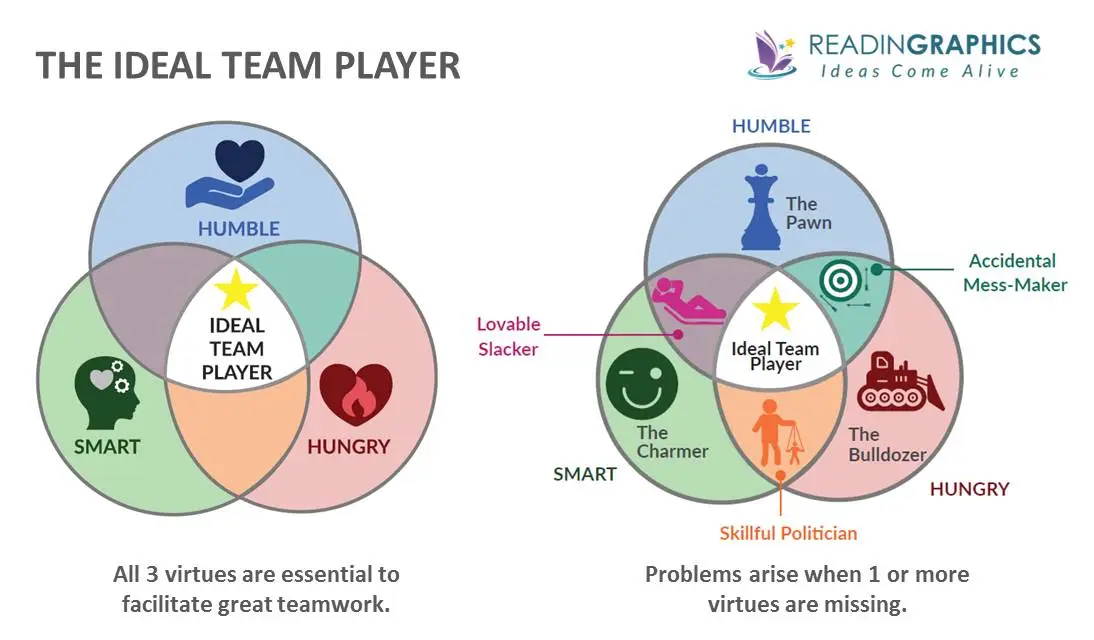
The Ideal Team Player for Your Dental Practice

Humility: 

  • Lencioni underscores the importance of humility as a fundamental virtue for team players. Humble individuals prioritize the needs of the team over personal recognition or ego. They readily admit mistakes, share credit with others, and actively seek feedback. Lencioni highlights how humility fosters trust, open communication, and a culture of continuous learning and improvement within teams. 

Hunger: 

  • The virtue of hunger refers to an individual’s relentless drive and passion to contribute to the team’s success. Hungry team players go beyond what is expected of them and are motivated to continuously improve their skills and make a meaningful impact. Lencioni emphasizes that leaders should seek out individuals who are self-motivated, proactive, and eager to exceed expectations, as they bring energy and commitment to the team dynamic. 

People-Smarts: 

  • The third essential virtue, people-smarts, focuses on an individual’s ability to understand and work well with others. Team players with high people smarts possess emotional intelligence, empathy, and strong interpersonal skills. They excel at building relationships, resolving conflicts, and collaborating effectively with diverse personalities. Lencioni explains how teams with members who exhibit people smarts are better equipped to navigate challenges and foster a harmonious work environment. 

Recognizing and Cultivating These Essential Virtues in Your Dental Practice 

“The Ideal Team Player” offers practical guidance on recognizing and cultivating these virtues within individuals and teams. Lencioni outlines strategies for hiring individuals who possess these qualities, providing actionable insights into conducting interviews and assessing candidates effectively. He also emphasizes the importance of ongoing coaching and development to nurture and strengthen these virtues in existing team members. The book offers tools and techniques to assess the current state of teamwork within your organization and offers actionable steps to create a culture that values and reinforces these essential virtues. These tools cover –  

  • Hiring the right people for your dental practice
  • Assessing current employees 
  • Developing employees 
  • Embedding this model into your organizational culture 

By embracing these principles and practices, you, as the leader, and your managers, can create high-performing teams within a culture of collaboration, trust and growth. Lencioni equips readers with the tools needed to transform their teams into cohesive and successful units, ultimately achieving exceptional results. The Ideal Team Player teaches you how to unleash the potential within your organization with the tools you probably already have and are under-utilizing.  

Optimize Your Results in Your Dental Practice 

At Optimize Practice Alliance, we know that a thriving dental practice isn’t built on systems alone, it’s built on people. High-performing teams don’t happen by accident; they’re shaped through clear expectations, strong communication, and consistent leadership.

That’s why we equip dental entrepreneurs with practical tools to strengthen team cohesion and accountability. One of the most effective is the DESC Coaching Template, a simple but powerful framework leaders use to address behaviors, clarify expectations, and resolve issues without tension or ambiguity.

The DESC model helps you:

  • Describe behaviors clearly and objectively
  • Express the impact those behaviors have on the team and practice
  • Specify what needs to change, or continue
  • Communicate outcomes and reinforce accountability

When leaders communicate with clarity and consistency, teams align faster, conflicts become productive, and trust strengthens across the organization.

If you want to move from talking about team alignment to actually creating it, this tool will help you lead the conversations that matter most.

Ready to strengthen communication and build a stronger team?

Supporting Dental Practices: The #1 Approach of Confident Leaders

Leadership As a Tool for Growth

How seriously do you take the concept of leadership in your dental practice? In my organization, we follow the EOS structure for our company meetings, team building and overarching goals and processes. Gino Wickman has created a comprehensive system for every aspect of running a successful organization. It truly works for us, and it has been a successful and exciting experience so far.  

We Practice What We Preach

We just had our 2nd Quarter, day-long meeting last week when we got to assess our first quarter and look ahead, plan and set realistic goals for our 3rd quarter. We also got to dig into some core issues within the company that were holding us back from accomplishing key benchmarks. These issues have been resolved and won’t be the issues that hold us back moving forward. There will be new issues to deal with in the next quarter and we will work those out using our EOS tools, as well, I have no doubt.  

During these meetings with our entire team, there are some wonderful, awful, dumb, ground-breaking and irrelevant ideas that get thrown around. There’s a lot of non-judgmental brainstorming that goes on in learning to move the needle in a new company.

What Does Lending Leadership Mean for your Dental Practice?

One of the ideas that came to me in the lead up to our Q2 meeting, is an idea I labeled, ‘Lending Leadership.’ I fell in love with this idea and threw it out to my team. They loved it too, because, as I explained to them, this is, essentially, our guiding principle with OPS. We are an organization dedicated to holding space for companies and practices while they integrate the processes, systems and structural changes they need to scale their organizations.  

These transitional times are confusing, challenging, scary and overwhelming for companies. What myself and my partner, Josh Gwinn, are dedicated to is lending our leadership during these times so that teams feel supported, directed and educated during these crucial transitions.  

The Concept of Lending Leadership

Another area we lend our leadership is through the process of evaluating your organization including what your practice looks like without more work from you, the practice owner. This is a crucial step in the scaling process. As the lead dentist, CEO, or leader of your organization you need to begin the process of extracting yourself from your daily activities within the practice while transitioning to working on the business. This entails even changing your calendar to reflect your new role within the company.  

As leaders who’ve gone through this very transition, both Josh and I, lend our leadership to making this transition as smooth as possible. And much of this transition involves changing your mindset. It might seem trivial but learning to move from the dentist’s chair into the role of leader/investor is an important and highly effective step in scaling your practice.  

It is your vision, direction and leadership that will shepherd your teams through the expansion process. And while your team is looking to you for direction, guidance and clarity you have the advantage of looking to us for expertise, mentorship and comprehensive team structure. We fill in the gaps until your teams are ready and able to guide the process.  

The Importance of Leadership in your Dental Practice

Lending our leadership ensures that you gain the highest valuation for your organization. This is a mutually beneficial process and outcome, and the guiding principle is your vision. In fact, the very first step we take at Optimize when working with new partners is what we call, Vision Day. We sit down with you and your teams to, above all, listen to what your vision for your organization is. If you’re not sure what your vision is we help you figure that out in a team setting so everyone is involved. Transparency, communication, honesty and compassion are the values we use to guide us through the Vision Day process.  

What Leadership Means to Us

We walk the talk. Our goal at Optimize is for our partners to gain clarity of their vision, be ensured of the highest valuation for their organizations, and be ready with strong teams, communications and processes in place for the scaling operation. This ensures mutual success and smiles all around. And it all starts with your vision, not ours. We are there to assist, clarify and lend leadership to provide a smooth experience for everyone. That’s how we roll.  

Mastermind your dental practice

Another Entrepreneurial Strategy That Works

Confident leaders don’t lead by reaction, they lead with intention. One of the most effective strategies any dental entrepreneur can adopt is creating clarity around what they stand for, where they’re going, and how they’ll get there. Without that clarity, even strong leaders can feel stuck, scattered, or unsure of their next move.

That’s why we created the Extraction GPS. This tool helps you clarify your values, assess your current reality, and define a clear direction forward so your leadership is grounded, consistent, and purposeful. When you know your destination, lending leadership becomes easier because your guidance is anchored in something real and intentional.

Lending Leadership at Optimize Practice Alliance

At Optimize Practice Alliance, we believe confident leadership starts with alignment. Our mission is to give dental entrepreneurs the tools they need to lead decisively, support their teams effectively, and build practices that reflect their values and long-term vision.

The Extraction GPS is one of the core tools we use to help leaders move from uncertainty to confidence. By defining what matters most and mapping a clear path forward, you create the foundation for stronger culture, better decision-making, and sustainable growth.

Ready to lead with clarity and confidence?

10 Essential Measures to Take before Scaling Your Dental Practice

 Are You Planning on Scaling Your Dental Practice Within the next 3 years? If so, there are certain measures you want to put into place before you even begin your scaling plan. Scaling a practice is a huge undertaking but there are certain steps to take now that will ensure your efforts are successful while building a stronger foundation for growth.  

Let’s say, you’re building a house. You need several essential elements. This will include sound architectural plans, a list of essential materials, trusted vendors, a team of contractors and workers, etc, to ensure you build a house that can withstand the elements, doesn’t become a source of toxicity for your family and will last beyond your lifetime. So, what if you’re building 30 more houses exactly like the first one? You need to duplicate those results. You’ll need a lot more of everything in greater numbers. Scaling is a big undertaking and in today’s economic environment it’s essential to any practice, eventually.  

It all starts with a healthy foundation, just like a house, or 30. Below, I’ve compiled a list of 10 implementations you start right now that will become the foundation of a much easier and more comprehensive scaling plan. And if you’re planning on beginning the scaling process in the next 3 to 5 years, you’ll want to get started now on implementing these measures. Starting now will mean less pressure, stress, drain on resources snd greater clarity of vision in the long run.  

10 Essentials Before You Scale Your Dental Practice 

  • Develop a Strong Brand Identity: Create a compelling brand that reflects the values and expertise of your dental practice. Use a professional logo, consistent color scheme, and cohesive visual elements across all your marketing materials.
  • Build an Online Presence: In today’s digital age, it’s crucial to have a strong online presence. Invest in a professional website that showcases your services, provides valuable information, and allows patients to book appointments online. Leverage social media platforms to engage with your audience and share educational content.
  • Prioritize Patient Experience: Focus on providing exceptional patient experiences. Train your staff to be friendly, empathetic, and attentive to patient needs. Implement efficient appointment scheduling, minimize wait times, and create a welcoming environment in your office.
  • Invest in Continuing Education: Stay up-to-date with the latest advancements and techniques in the dental industry. Attend conferences, seminars, and workshops to expand your knowledge and skills. This will enhance your credibility and ensure you can offer the best treatments to your patients.
  • Embrace Technology: Incorporate cutting-edge dental technologies into your practice. Invest in digital radiography, intra-oral cameras, and CAD/CAM systems to improve diagnostics, treatment planning, and patient communication. Technology can streamline your workflow and enhance patient outcomes.
  • Implement Effective Marketing Strategies: Develop a comprehensive marketing plan to attract new patients and retain existing ones. Utilize a mix of online and offline marketing channels, such as search engine optimization (SEO), pay-per-click advertising, social media marketing, direct mail campaigns, and patient referrals.
  • Provide Patient Education: Educate your patients about oral health, preventive care, and the benefits of regular dental visits. Create informative blog posts, videos, and brochures to empower patients to take better care of their teeth and gums. Informed patients are more likely to become advocates for your practice.
  • Foster Relationships with Specialists: Collaborate with other dental specialists in your area to offer comprehensive care to your patients. Establish referral networks and build strong relationships with orthodontists, oral surgeons, periodontists, and Endodontists. This collaborative approach will enhance patient satisfaction and expand your network.
  • Focus on Practice Management: Efficient practice management is crucial for success. Implement robust systems for appointment scheduling, billing, and patient records. Train your staff on proper communication and customer service skills. Regularly evaluate your practice metrics to identify areas for improvement.
  • Engage in Community Involvement: Demonstrate your commitment to the community by participating in local events, sponsoring sports teams, or organizing oral health awareness campaigns. Building a positive reputation in the community will help you attract new patients and foster loyalty among existing ones.

Scaling Your Dental Practice Starts with Visibility, Not Guesswork

How many of these foundational measures are already in place in your dental practice? How many are still ideas on paper? Scaling successfully isn’t about ambition alone, it’s about knowing, with clarity, whether your practice is actually prepared to grow.

True scale requires more than clinical excellence. It demands operational awareness, disciplined execution, and the ability to duplicate what’s working without creating chaos. The practices that scale well don’t guess, they track.

That’s why we created the OPA KPI Tracker. This tool helps dental entrepreneurs measure the metrics that matter most before, during, and after scaling. It gives you visibility into performance, highlights gaps early, and helps you decide where to focus your time, energy, and resources so growth feels intentional, not overwhelming.

Scaling done right is never all on your shoulders. It’s supported by systems, data, and a team aligned around clear priorities.

Thinking about scaling your dental practice?
Download the KPI Tracker to gain clarity on your readiness, focus on what truly drives growth, and build a foundation that supports sustainable expansion.

At Optimize Practice Alliance, we believe the future of dentistry belongs with dentists and clarity is one of the most powerful tools you can use to keep it that way.

8 New and Emerging Technologies for Your Dental Practice

It’s a brave new world for your dental practice. Let’s look at how to optimize it for your best outcomes. Back in March I attended Abundance360, an incredible mastermind hosted by Peter Diamandis, bringing together sharp intellectual minds from across the ideological and economic spectrum. The mastermind is designed with one goal: to upgrade your mindset so you’re ready for the incredible advancements every single business, philanthropic and investment sector is facing in the 21st century. If you want to up your game, this is the place to be, learn and grow from the best of the best.  

Since then, I have been fervently delving into new technologies affecting the dental industry and dental practices specifically. The landscape for dental advancement is astounding and constantly changing. So, I thought I would list some of the most crucial new technologies here to give you, the dentist and dental practice owner, an overview of the brave new world of dentistry in the 21st century.  

It’s an exciting, challenging and sometimes overwhelming phase for our industry so I hope this list gives you some insight, knowledge and even direction for where you want your dental practice to go and how you want to get there.  

8 Emerging Technologies to Consider for Your Dental Practice 

As the dental industry continues to evolve, new technologies are constantly being developed to improve patient care, enhance diagnosis and treatment, and streamline dental practice management. In this post, I explore eight cutting-edge and emerging technologies that are revolutionizing the field of dentistry. From advanced imaging systems to artificial intelligence-powered tools, these innovations are transforming the way dentists work and improving overall dental experiences for patients.  

1. 3D Printing in Dentistry: 

  • The advent of 3D printing technology has opened up a world of possibilities in dentistry. From creating precise models for orthodontic treatments to fabricating crowns and bridges, 3D printers enable dentists to produce custom-made dental prosthetics quickly and cost-effectively. This technology reduces turnaround time, enhances accuracy, and allows for greater patient involvement in treatment planning. 

2. Augmented Reality (AR) for Dental Patient Education: 

  • AR technology provides a unique opportunity for dentists to enhance patient education and treatment understanding. By using AR glasses or smartphone apps, dentists can overlay digital information onto the patient’s real-time view, helping them visualize treatment options, outcomes, and oral hygiene techniques. This interactive approach improves patient engagement and empowers them to make informed decisions about their dental health.

3. Artificial Intelligence (AI) in Dental Diagnosis: 

  • AI algorithms are now being employed in dentistry to assist in the early detection of oral diseases, such as cavities and periodontal conditions. By analyzing digital images, AI-powered software can quickly identify abnormalities and alert dentists to potential problem areas. This technology enables more accurate and efficient diagnosis, leading to timely intervention and improved patient outcomes.
AI Technology is here to stay

4. Teledentistry for Your Dental Practice: 

  • Teledentistry is rapidly gaining popularity, especially in remote areas and underserved communities. Through secure video conferencing, dentists can remotely assess and diagnose oral health conditions, provide treatment recommendations, and offer follow-up consultations. Teledentistry improves access to dental care, reduces travel time and costs for patients, and allows for prompt intervention, ultimately leading to better oral health outcomes. 

5. Digital Impressions: 

  • Digital impression systems have replaced traditional messy impression materials with intraoral scanners, simplifying the process of capturing accurate dental impressions. These scanners create highly detailed 3D digital models of patients’ teeth and oral tissues, eliminating the discomfort associated with traditional impressions. Digital impressions enhance the accuracy of restorations, such as crowns and veneers, and facilitate seamless communication between dentists and dental laboratories. 

6. Laser Dentistry: 

  • Laser technology has made significant advancements in dentistry, offering numerous benefits over traditional tools and techniques. Dental lasers are used for various procedures, including gum contouring, cavity preparation, and soft tissue surgeries. Lasers minimize discomfort, reduce bleeding and swelling, promote faster healing, and can even sterilize the treatment area. The precision and versatility of lasers make them indispensable tools for modern dental practices. 

7. Cone Beam Computed Tomography (CBCT): 

  • CBCT imaging systems provide detailed 3D images of a patient’s oral structures, including teeth, jawbones, and surrounding tissues. Unlike traditional 2D dental X-rays, CBCT scans offer a comprehensive view, aiding in accurate diagnoses, treatment planning for dental implants, and orthodontic evaluations. This advanced imaging technology enhances the dentist’s ability to visualize anatomical structures and deliver more precise and personalized treatments. 

8. Robotic Dentistry: 

  • Robotic systems are entering the dental field, assisting dentists in performing complex procedures with enhanced precision and control. These robots can assist in tasks such as dental implant placement, tooth extractions, and root canal treatments. Robotic dentistry improves procedural accuracy, reduces the risk of human error, and enhances patient safety and comfort. 

The Future of Dentistry Belongs with Dentists 

The dental industry is experiencing a rapid wave of emerging technologies, from AI-driven diagnostics to advanced imaging, automation, and digital workflows. These innovations are reshaping how dentists diagnose, treat, and manage care, while also improving patient experience and operational efficiency.

But technology alone doesn’t create progress. The practices that benefit most from innovation are the ones that adopt new tools with intention, measuring impact, tracking outcomes, and making decisions based on data rather than excitement. When implemented thoughtfully, technology can reduce wait times, improve team efficiency, support scalability, and increase the long-term value of your dental practice.

That’s why we created the OPA KPI Tracker. This tool helps dental entrepreneurs evaluate how new technologies are actually affecting performance, so you can see what’s working, what’s not, and where to invest next. When your decisions are grounded in clear metrics, innovation becomes a strategic advantage instead of a financial risk.

Thinking about scaling your dental practice through technology?

The Power of Servant-Leadership in Your Dental Practice: #1 Secret to Cohesive Teams

In my quest to understand how to be a better leader within my organization and move from dentist to investor in my dental practice, I discovered a piece of writing that became an invaluable tool of my leadership development. In his 1977 essay, The Servant As Leader, Robert K. Greenleaf coined the term servant-leadership. Servant-leadership as a philosophy that centers the organization and its leaders as servants to a greater community.

In his essay, Greenleaf describes the necessary qualities and characteristics of servant-leadership and how these qualities contribute to a healthier organization, community and society at large. He also details the skills necessary for effective leadership.

Using Servant-as-Leader Skills in Your Dental Practice

The skills such as awareness, empathy, the ability to listen, anticipation of obstacles are the foundational activities that resonated with me as being the type of leader embodying the values I also wanted to instill throughout my organization.

Improving leadership in your dental practice

Servant-Leadership Skills Vs. Traditional Leadership Qualities in a Dental Practice Setting

  • Servant-Leadership
  • Listens as a Practice
  • Practices Empathy
  • Leads with his/her values
  • Is Aware of Strengths & Weaknesses
  • Practices Inclusivity in Decision-Making
  • Measures Success through a holistic lens
  • Traditional Leadership
  • Speaks as a Practice
  • Leads through Control
  • Is not necessarily guided by personal values
  • Uses Leadership as a rank of value
  • Top-down Decision-Making
  • Measures Success only through Output

My Own Story of Learning to Lead

In my book, Extraction: The Surprising New Formula to Systemize, Scale and Sell Your Business, I go into the skills, principles and qualities I use to guide my leadership style. In fact, I dedicate an entire chapter to this called Leadership and Execution. But it was this pamphlet that really started it all for me, in how I look at leadership and the way I have molded my own path to leadership.

Applying Leadership Skills and Values in Your Dental Practice

This little pamphlet had a profound effect on me. Within its unassuming pages I found a path for instilling my personal values into my leadership style and using them to help me guide my practice in a way that felt most comfortable for me and that honored all voices within my organization. It’s a quick read and I hope you enjoy it as much as I did.

These are the same values, principles and skills that today guide Optimize Practice Alliance. We really are an organization that practices what it preaches and espouses as its values. If you would like to learn more about OPS, what we stand for and how we can help your organization, take a fast and free assessment and get in touch! We’d love to find out about you too!

Practicing Servant-Leadership in Real Time

One way to discover your values, brush up on your leadership skills and work out your challenges around leadership issues is to speak with other dentists who’ve been in your shoes. Our CEO, Josh Gwinn, runs a monthly mastermind exclusively for dentists.

Each month dentists come together to discuss their biggest issues and find solutions, celebrate each others’ wins and provide feedback and resources to overcome challenges and roadblocks in their practices. It’s an incredible opportunity for dentists to brainstorm together and create a community that works for them. It’s also in alignment with our motto,

We believe the future of dentistry belongs with dentists

Through the values that our founder and president, Dr. Jack Bayramyan, founded OPS on, we are dedicated to providing tools, solutions and long-term strategies to dentists no matter what stage of growth they find themselves. This includes bettering themselves in their mindsets and as leaders of their organizations. Now, you may be asking yourself, what is a mastermind?

Practicing Servant Leadership in Real Time

Servant leadership starts with clarity: clarity about your values, your purpose, and the kind of leader you want to be for your team and your patients. It’s difficult to serve others well if you haven’t first taken the time to define what truly matters and where you’re leading your organization.

That’s why we created the Extraction GPS. This tool helps dental entrepreneurs slow down long enough to clarify their values, assess where their practice is today, and define a clear direction forward. When your vision is rooted in service and intention, leadership decisions become more thoughtful, more consistent, and more impactful.

At Optimize Practice Alliance, we believe the future of dentistry belongs with dentists and that future is built by leaders who serve with purpose, humility, and clarity.

One of the Greatest Strategies of Servant Leaders

Great servant leaders don’t rely on instinct alone, they operate from alignment. They understand that values-driven leadership requires a clear roadmap, so their actions consistently reflect what they stand for.

The Extraction GPS was designed to help you translate servant leadership principles into action. By clearly defining your values, long-term vision, and priorities, you create a framework that supports your team, strengthens your culture, and guides your practice through growth and change with integrity.

When your direction is clear, service becomes sustainable. Your team knows what you stand for. Your decisions reinforce trust. And your leadership creates lasting impact.

Ready to lead with clarity and service at the center?

For Dental Practice Owners: 2 Bold Leadership and Execution Principles

The following is an excerpt of my book, Extraction: The Surprising New Formula to Systemize, Scale and Sell Your Business. These are the insights I gained into the meaning of leadership and how I was able to successfully scale my business from 1 to 8 practices before selling my organization. Learning to change my attitude to leadership allowed me to build strong teams that supported a new vision that would eventually lead me to a successful scale and exit strategy.

Extraction for your Dental Practice

Below are two qualities that, in my opinion, leaders need to successfully execute on their visions, no matter what that vision may be or what values you hold as a leader.

Tools that Shape Visionary Leaders

Building effective leadership is the core resource of successful execution. I would like to share with you two of the foundational qualities of leadership required to unleash effective execution of one’s vision. But what is truly essential for execution? You need a strong vision and you need team buy-in. And before either of those, you need credibility. So, how do you establish vision, buy-in and credibility? You must first develop yourself.

I have always been a seeker of knowledge and an avid student of human motivation, both mine and others’. That searching for knowledge and understanding of how humans work has led me to incredible insights. I have discovered key leadership principles and characteristics by reading the works of experts and attending seminars as well as one-on-one coaching and mentoring sessions.

Extract Yourself from the Way It’s Always Been Done

There are two principles specifically that I want to address here through excerpts from my book. I hope these insights bring you greater clarity and awareness about your own gifts as a leader in your dental practice or organization. As an entrepreneur, you have the skill and gift of leadership already. After all, you’ve led your teams this far, haven’t you? Now it’s time to up your game and refine your leadership skills through gaining buy-in and establishing your credibility.

Principle #1: Leaders are Forward Thinkers

Effective leaders are forward thinkers who can see their own potential as well as that of their teams. They constantly seek to maximize the potential value creation of their customers as well as their organization’s ability to fulfill their customers’ needs. Great leaders can clearly see around corners. The future is as real to them as their current reality because effective leaders can clearly see, feel and be in their future vision. They absolutely believe it is achievable and this optimism gives them a situational awareness of possible future roadblocks and obstacles.

Principle #2: Master Your Own Integrity First

Powerful leaders uphold the highest level of integrity in themselves and in their work. This level of integrity is more than the virtue of being an honest person. This integrity in a leader is the ability to develop authenticity, vulnerability, immediate access to emotions and a belief system. These qualities engender trustworthiness in the leader by the organization’s team.

Subsequently, this level of trustworthiness felt by their teams translates and engenders credibility from their customers and vendors. This level of trust allows leaders to follow through on their visions for growth and risk. These leaders have the ethical courage to do what is right no matter what the cost, even if it means being disliked, or resulting in short-term revenue loss. Doing what one believes to be true, and right, is foundational to showing up with integrity and earning the trust of your teams.

Competent leaders are good at, and committed to, self-mastery. They are always experimenting with new ideas, allowing themselves to make mistakes and learn from them in order to improve on processes. As a clinical dentist, I was limited on experimenting outside of established clinical guidelines to preserve the health and safety of my patients, but operationally I was willing to experiment with ways that improved the experience of our customers and our teams.

We must continue to strive to find easier ways for our teams to deliver a better experience to our customers. We must be willing to experiment, try new things and get feedback. These steps are the raw material for us to course-correct and innovate, coming up with multiple pathways to get to our desired results and fulfill our visions.

Competent leadership also means providing the courage and giving permission to our teams to take their own risks, to make mistakes, to take ownership and transform their own feedback into growth opportunities. This is how we continuously become more competent and confident in our abilities to execute on new ideas and keep growing.

Conscious leaders create a culture that welcomes and embraces change and creates opportunities for innovation and progress without being confined by the dangerous trap of old habits. Conscious leadership consciously breaks an organization out of the mindset: we have always done it this way.

People follow the visionary more than they follow the vision

We see this phenomenon throughout history with both creative and innovative results as well as destructive and treacherous outcomes. During the early 1930’s, Hitler was considered a bold visionary for his prescription for the German people. Millions were blinded by that vision with devastating and catastrophic results. Contrast this to Gandhi’s vision for a free and democratic India which was the culmination of a lifetime of peaceful, non-violent protest.

Gandhi’s vision was taken up by millions, time and time again, and continues to influence people all around the world to this day. It is the visionary rather than the vision that attracts people over and over. You may not be fighting to free people from unfair systems of governance, but you are fighting for your business to survive and thrive whether you feel comfortable picking up that mantle or not. So how do you become an effective leader whose vision your people become passionate about?

Don’t Burst Through your Comfort Zone, Expand it

Effective leaders must learn to challenge and stretch themselves beyond their comfort zones and old habits, while being willing to try new ideas, technology, processes and skills. This gives their teams permission to follow this paradigm for growth. That is why it’s imperative for you, as a business owner, to learn to transform your mindset into an effective leader and successful investor. Learning to work on your business rather than in your business is a personal transformation first and foremost.

So how do you adopt an investor’s mindset for your own organization? It starts with how you see your business. When you started your business, did you give yourself a job, or did you make an investment? It all comes down to mindset.

Learning to Invoke Leadership Qualities in Your Dental Practice

In the rest of Chapter 6 I delve into 3 more qualities I used that turned my mindset and subsequently my company’s success around. I also redefine what it means to be a leader in the 21st century by unpacking the wisdom of the past. I hope you give it a read. Using these insights were invaluable to my success and I know they will be for you as well.

Put Bold Leadership into Practice

Bold leadership isn’t theoretical, it’s built through clarity, conviction, and consistent action. The two principles you explored here require more than motivation; they require a clear vision and a plan that guides your decisions when things get hard.

That’s why we created the Extraction GPS. This tool helps dental practice owners clarify their values, define where their practice is today, and map out a bold, intentional path forward. It turns leadership principles into a practical roadmap so you’re not just reacting to challenges, but leading your practice with purpose.

When your vision is clear and your goals are defined, leadership becomes less about guessing and more about alignment. Your team knows where you’re headed. You know what matters most. And progress becomes measurable.

Ready to lead with clarity and intention?