Dr. Jack Bayramyan

The Extraction Formula: The #1 Tool for Dental Practice Success

The Obstacle is the Path in Your Dental Practice  

If you’re a dental practice owner, have you read Extraction yet? Recently, I published my first book, Extraction: The Surprising New Formula to Systemize, Scale, and Sell Your Practice. The response from readers has been overwhelmingly positive, and we’ve made Bestseller status on Amazon in several categories! I’m proud of this achievement. It started as a simple enough idea. I had been working with my dear friend Sean Stephenson who was coaching me in my business. In fact, it was Sean who coined the title, Extraction.   

Extraction for your Dental Practice

His fundamental drive in life was to help others extract themselves from the prison of their own mindsets to achieve greater levels of personal freedom and fulfillment. Many times in my journey, I have found myself in my own self-imposed prison. For example, right after the pandemic, I injured my neck and hand and discovered that clinical dentistry was something I could no longer practice. I was at a loss; I was nervous about what my future may hold for me, and I was searching for new meaning.   

Sean’s life and mentorship reminded me that meaning lies in what we do in service to a greater cause. Of course, we can always amass more: more wealth, more success, more money, more stuff. But we aren’t going to find much meaning in any of that. To find true meaning, we must train our abilities and skills to contribute to our families, communities, and society because purpose comes from serving others. And that was the spark of an idea that eventually became my book.    

Why I Wrote Extraction  

My injury became a blessing in disguise. It forced me to take stock of myself, my career, and how I can continue contributing differently as an author and entrepreneur as much as I did as a clinical dentist. I had to forge a new path for myself, and that path would be rooted in a principle I have stuck to my entire career, the true measure of one’s success is creating value in the lives of others.   

I wrote Extraction mainly for Dental Entrepreneurs. I wanted to bring a set of strategies I used over two decades to build, scale, and finally exit a tremendously successful dental organization that continues to serve and thrive today. By laying out my strategies, mistakes, obstacles, and achievements, I can help other dental entrepreneurs avoid the same mistakes and challenges I faced.   

Breaking Free from Your Dental Practice  

There is another fundamental reason I wrote my book. While building my organization, I ran into a paradox. As I continued to build and scale my practice, I became increasingly enveloped with the day-to-day challenges of running a multi-practice organization. I needed to take a 10,000-foot view of my organization and where it was headed. I was, in fact, mired in the minutiae of daily operations. This needed to be more sustainable. I coined a term for this place I had landed in the trajectory of “success,” I call this place the dental entrepreneurial prison. I wrote about this concept in an earlier blog post.     

It is deeply frustrating for an entrepreneur to work tirelessly day after day for years to find that the success you’re gaining is only giving you a ton more work and less meaning and fulfillment. So, how do you avoid getting locked in a prison of your own making?

A New Formula for Success

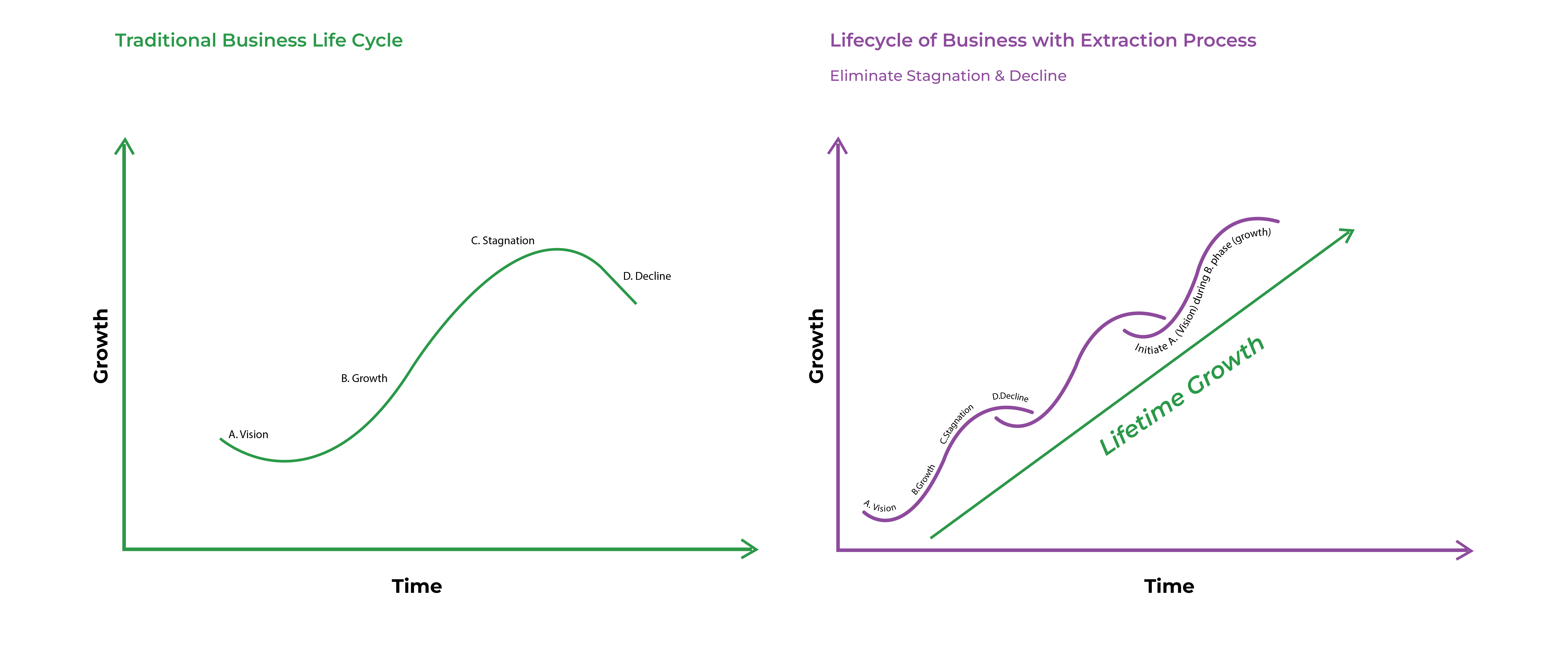
The formula I’ve created and defined in Extraction is designed to help you avoid this paradox and many others as you build your practice and organization. The first step in this formula is to define your Point A. Where are you in your life as an entrepreneur? Do you know how to define it? And where is your organization in its lifecycle? Determining where you and your practice(s) are will allow you to map out a path for where you want to go and, importantly, how you want to get there.  

Defining the Roadmap, From Point A to Point B 

After you honestly and fully understand where you are in your practice, your Point A, we define your vision. Dreaming big is imperative to your overall dental practice strategy and growth. But ‘big’ means different things to different people. In the book, I walk you through the steps of defining a personal vision for yourself and your dental organization that works for you, not your competitors, fellow entrepreneurs, or even what your family wants. We figure out what you want for your life and your business. Vision is not a destination. It sets the direction of your growth.  

Next, we figure out how we will move toward your vision. And it is here where we ensure you stay focused on building your roadmap or strategic growth plan by assessing all the internal and external obstacles that stand in the way of realizing our vision. At this point, we’ve built your dream team to support you and implement your strategic plan. We also break down your company goals into yearly, quarterly, monthly, weekly, and even daily steps so everyone is transparent and accountable. Finally, you create a template of actionable steps to keep you on track to meet your goals and, eventually, execute your vision.   

From Dentist to Dental Entrepreneur and Investor

Finally, we hone your skills as a leader. You invested time and money in dental school. But unfortunately, dental schools fail to teach us how to be a leader of successful teams. Dental schools also fail to teach us how to be an entrepreneur in a successful, scalable organization. That’s our job.

In my book, I lay out all of the values and principles that allowed me to become the leader I needed to be, not just for my organization or my teams, but for myself. I needed to find a way to break free from the dental entrepreneurial prison, and that meant becoming a leader that people trusted enough to carry out a vision that I laid out for them that they couldn’t quite see yet. They needed to trust me to hold that vision for them while they worked toward it. We did it, and you can too.   

Invest in Yourself, Not Just Your Dental Practice   

Avoiding the paradoxes of entrepreneurship is daunting while you’re building your practice and organization. But there are concrete steps you can take to avoid those traps; traps like stagnation in your business growth and the paradox of success. I wrote my book specifically outlining how to avoid those pitfalls or get out of them once you’re in.

But your business, practice, and organization will always have challenges and obstacles. The aim isn’t to remove all the obstacles. That’s an impossibility. The aim is to see those obstacles as the path to your success. Each obstacle becomes a lesson of growth. I hope I can assist you on your path and lighten your load as a dental entrepreneur.   

The mind adapts and converts to its own purposes the obstacle to our acting. The impediment to action advances action. What stands in the way becomes the way.”
~Marcus Aurelius

In fact, I didn’t just write a book to help the dental entrepreneur; I built a company too. Optimize Practice Alliance is dedicated to assisting the dental entrepreneur in building a solid organization and a lasting legacy. Our motto is our mission, keeping the future of dentistry in the hands of dentists. Our goal is empower dentists to become the masters of their own destiny, however that looks to each entrepreneur.

Turn the Extraction Formula into a Clear Plan

The Extraction Formula isn’t just about working harder or adding more tactics, it’s about leading with clarity, intention, and alignment. Real growth happens when you know where you’re going, why it matters, and how each decision moves you closer to that vision.

That’s why we created the Extraction GPS. This tool is designed specifically for dental entrepreneurs who want to translate the principles of the Extraction Formula into a practical, actionable plan. It helps you clarify your values, define where your practice is today, map out your long-term vision, and break that vision down into annual and quarterly priorities you can actually execute.

When your vision is clear, leadership becomes easier. Obstacles feel more manageable. And your team can align around something bigger than day-to-day tasks.

Ready to put the Extraction Formula to work in your practice?
When is The Right Time to Move from Dentist to Investor in Your Dental Practice?

Are you ready to be an investor in your dental practice? This is a big question, but the answer is deceptively simple, and you don’t have to give up practicing dentistry to make the transition. However, there are several factors to plan for and implement to make this transition successful.

So, here’s the answer, the right time to transition from dentist to investor in your practice is when the revenue of your practice finally comes mainly from your team. Transitioning your mindset from clinician to investor is another story –  

How Do You Transition from Dentist to Investor in Your Dental Practice?  

How do you get your revenue to start coming from your team rather than yourself? You must build the foundation to scale your practice before you make that transition. There are several elements involved in this process:  

  • You need to onboard new doctor associates 
  • You need to train these new associates in the vision, processes, and culture of your dental practice 
  • You need to redesign your schedule to transition your time from mostly clinical hours to mostly administrative hours 

Once you’ve effectively implemented these strategies, then you will be ready to transition to investor. You can and should keep clinical hours, but those are minimal compared to the time you use each week for scaling out your business as an investor.  

Check out this short video on my process for transitioning from solely dentist to dentist-investor in my practice:  

Are You Ready to Become an Investor in Your Dental Practice?  

Transitioning from dentist to investor is one of the most important, and challenging, shifts in a dental entrepreneur’s career. While the opportunity is exciting, it only works when the right foundations are in place: strong teams, clinical duplication, and the ability to view your practice as an investment rather than a job.

At some point, many dentists realize they didn’t just build a business—they built themselves another chair to sit in. Reclaiming the entrepreneur role requires stepping back, gaining perspective, and intentionally designing the future you want your practice to support.

That’s why we created the Extraction GPS. This tool helps dental entrepreneurs clarify their values, assess their current reality, and define a clear path forward, so you can decide how (and when) to transition into the investor seat with confidence. It gives you the structure to align your vision, your role, and your growth strategy before making big moves.

At Optimize Practice Alliance, we believe the future of dentistry belongs with dentists, and that includes dentists who are ready to think, lead, and invest like owners.

Ready to step into the investor role with clarity and intention? 

Escaping the Dental Entrepreneurial Prison: A Personal Perspective from a Prison Escapee

AI and Your Dental Practice: 6 Actionable & Achievable Applications

Is your dental practice ready for the future? I recently attended the Abundance360 Summit hosted by Peter Diamandis. Abundance360 is an annual event where “visionary entrepreneurs, investors, and executives meet to solve the world’s biggest challenges.” It’s a yearly mastermind with community-led mini-masterminds, monthly workshops, and year-round coaching designed to support entrepreneurs to challenge their mindsets and expand their comfort zones constantly.  

This year’s theme for the event was about learning to leverage new technologies, specifically AI, in your business. The summit provocatively stated, “In the next ten years, we’ll experience more progress than in the last 100 years.” There is so much new technology, sensors, AI, robotics, 3D printing, synthetic biology, blockchain, etc., that it can be highly intimidating and challenging to know what to implement in your dental practice, much less how.  

New Technologies and Your Dental Practice 

Abundance360 wants to inform, instruct and guide entrepreneurs on how and where to use these technologies so business owners feel empowered to use them rather than be so intimidated they walk away. Doesn’t it feel like we’ve already been moving at light speed in the first half of the 21st century? How can we go any faster? And if we, as entrepreneurs, are not ready, we will be left behind. So, I want to use this post to enlighten you about new and emerging technologies and how they might fit into your practice. My goal is to inform and prepare you, the dental entrepreneur, so you feel excited, rather than overwhelmed, by what is coming. 

One of the recurring themes of the conference was to show businesses that fail to incorporate AI within the next 5 to 10 years would be left behind or eliminated. While the conference covered a broad range of sectors, I was most interested in how AI applied to dental practices and the dental industry. In this blog post, I’ll explore the potential ways AI can be integrated into dental procedures and the benefits they will bring to dental entrepreneurs. Let’s dig in.  

AI in your dental practice

Six Areas of Emerging Technologies Applied to Dental Care 

So much new technology is being designed, created, and innovated that figuring out where to start feels challenging. Below are six areas of emerging technology that I’ve curated for this post that are simple to investigate and implement in your practice.  

Of course, you will face some challenges, there will be a learning curve, and you may even experience push-back from your teams and even your patients. Still, taking all of this in stride and creating a new mindset of embracing challenges, these new tools will enhance rather than hinder your practice.  

AI Diagnostic Support in Your Dental Practice 

  • One of the most immediate applications of AI in dentistry is its ability to enhance diagnostic accuracy. AI-powered tools can analyze X-rays and dental images, quickly identifying issues the human eye could miss. With a more accurate and timely diagnosis, you can provide more targeted and better treatment plans, ultimately improving patient outcomes. 

Dental Patient Engagement and Communication 

  • Your dental practice can leverage AI chatbots and virtual assistants to enhance patient communication and response. By handling appointment scheduling and reminders, AI can streamline administrative processes and free your staff to focus on more critical tasks. Furthermore, AI-powered virtual assistants can provide personalized oral health tips, answer FAQs and check in with patients on their health plans fostering deeper patient engagement and promoting preventative care. 

Treatment Planning and Customization for Dental Practices 

  • Advanced AI algorithms aid you in developing personalized treatment plans by analyzing various factors such as a patient’s medical history, current known conditions, and personal preferences. So, then you can create tailored treatment plans that cater to your patient’s unique needs. This way, you use AI to consider many factors rather than yourself, trying to remember and write down every patient’s specific condition, requirements, preferences, etc.  

Robotic-Assisted Dentistry 

  • Although still in its infancy, robotic-assisted dentistry holds tremendous potential for the future. AI-powered robots can assist dental professionals in intricate procedures with increased precision, reduced fatigue, and shortened procedure time. As technology advances, we can expect to see more complex procedures being carried out with the help of AI-driven robotics.  

Dental Practice Management and Efficiency 

  • AI has the potential to revolutionize your practice management by automating repetitive tasks and optimizing resource allocation. From inventory management to billing and insurance claim processing, AI can identify patterns and trends that lead to cost-saving opportunities and more efficient operations. We see these applications already in companies like Amazon and industries like shipping logistics. And that same type of application can be implemented in your dental practice to streamline specific tasks and processes.  

Continuing Education and Skill Development within the Dental Industry 

  • Finally, using AI-driven educational tools, you can stay updated with the latest industry advancements and best practices. AI can also help you identify knowledge gaps and recommend targeted learning materials, ensuring you remain at the forefront of your field. How incredible is that? An AI tool will automatically give you reminders, strategies, and tools to keep you competitive and informed about new knowledge and technology; that is a game-changer.    

A Brave New World for Dental Entrepreneurs—Grounded in What Matters

Integrating AI into your dental practice opens powerful opportunities for optimization and growth. From improving patient outcomes to streamlining administrative tasks, the potential is real—and accelerating fast. Dentistry is no exception to this shift, and adopting the right technologies can absolutely strengthen your practice’s long-term relevance and competitiveness.

But with innovation moving this quickly, it’s normal to feel overwhelmed. Where do you start? Which tools actually make sense for your practice? And how do you know whether a new technology is helping—or just adding complexity?

The most effective way to approach AI is to ground innovation in clear performance metrics. That’s why we created our KPI Tracker, to help dental entrepreneurs measure what truly matters before, during, and after adopting new tools. When you know your numbers, you can confidently test new technologies, evaluate impact, and scale what works—without guesswork.

Start small. Choose one or two innovations that align with your goals. Track the results. Let your data guide your decisions.

Ready to innovate with clarity instead of overwhelm?

#1 Rule of Successful Dental Practice Owners: Measure What Matters 

Do you measure what truly matters in your dental practice? Nearly every conversation I have with a fellow dentist-entrepreneur circles around how to know your investment and time is working, ‘how do you know that you’re actually growing your dental practice?’ 

You Can’t Improve What you Do Not Measure

Common sense tells us that in order to keep improving you must keep examining the results of what you’re doing. What is the point of doing a tremendous amount of work unless you’re going to review it to see what has been effective and what has been a waste of time? 

“In God we trust, all others bring data.”

-W. Edwards Deming

Reading a slew of reviews about a business who consistently makes incredible hamburgers but their fries are always soggy is literally reading the lagging indicators of a business that refuses to accept feedback and examine its protocols to address what is working and what is not. Reviews are one way to gain insight into what’s working in your business and what’s not working. They are also a look back into the near past: one person’s recent experience at that one hamburger joint. Make sense?

Here’s What to Measure in your Dental Practice

So, how do you measure and what do you measure? Two vitally important questions every business needs to ask and answer constantly and consistently.  

In the case of dental patient treatment plan acceptance, patient nurturing and dental patient experience, not all actions are created equal. Some of our actions have a greater impact on our environment than others and it’s a good idea to know which ones have a greater impact and which ones have a weaker impact.  

Lead Measure Vs. Lag Measure

First, let’s define some terms. Lead measures or lead indicators help you predict which actions might successful and which might not, in other words, what to keep doing to keep getting the same successful results.  

A lag measure or lag indicator, measures your wildly successful goal with results that have already passed like profit, revenue, and patient satisfaction. They are a little harder to gauge because the results are correlated to actions taken in the past.  

In my book Extraction: The Surprising New Formula to Systemize, Scale and Sell Your Business, I breakdown different forms of measurement and the importance measuring growth and goal achievement play in your leadership role. Let’s look at three measurable areas of your practice here.  

Dental Practice Revenue Growth

  • Leading Indicator: The leading indicator here is the Number of Qualified Patient Leads. By measuring the number of qualified leads generated, your business can predict future sales growth. In a dental practice, your qualified leads are patients who call for an appointment—for a service you can provide with a payer you accept. If the number of qualified leads is increasing, it’s likely that sales growth will follow. If your qualified leads are decreasing this is an area that you want to pay attention to with your team to decide why they are decreasing and what can be done to stop and reverse the trend, essentially get ahead of the ‘problem’ before it becomes one.  
  • Lagging Indicator: Dental Practice Production or Revenue. Production or revenue is a lagging indicator because it shows the results of past sales efforts. As we know, production in your dental practice doesn’t happen if the patient doesn’t show up, accept the treatment plan, and ultimately pay for the dental care you delivered. After sales have been made, revenue is generated, but this data is historical and cannot be used to predict future sales growth. It can help you look back and evaluate what you and/or your team did to increase revenue or the reverse: review what you did that possibly decreased revenue.  

Safety in Your Dental Practice

  • Leading Indicator: Number of Safety Training Hours. By measuring the number of safety training hours completed by employees, including HIPAA and OSHA trainings, a business can predict the likelihood of workplace accidents. There is a documented correlation of safety in the workplace to awareness of rules, laws, regulations and best practices. If the number of safety training hours is increasing, it’s likely that the number of accidents will decrease in the future. 
  • Lagging Indicator: Number of Workplace Accidents. Workplace accidents are a lagging indicator because they represent past events that have already occurred. By the time an accident is recorded, it’s too late to prevent it from happening. But it’s not too late to review protocols, training hours and best practices to ensure accidents decrease and awareness of safety protocols are top of mind for your employees.  

Managing Employee Turnover in Your Dental Practice

  • Leading Indicator: Employee Engagement. By measuring your employee engagement through surveys, anonymous feedback systems, communications and strong morale engagement, your business can predict your future turnover rates. If your employee engagement is low, it’s likely that turnover rates will increase in the future. 
  • Lagging Indicator: Employee Turnover Rate. Your employee turnover rate is a lagging indicator because it shows the results of your past employee retention efforts. After employees have left, turnover rates can be calculated, but this data is historical and cannot be used to predict future turnover rates. However, if your turnover rate is high, you can take a look at your employee engagement protocols to see what is lacking and where you can improve employee engagement.  
What Type of Growth is Expected in My Dental Practice?

The Measurement of Growth is A Measure of Leadership

These are just a few examples of how using and measuring your leading and lagging indicators can improve so many areas of your dental practice. The key takeaway is that leading indicators can be used to predict future outcomes, while lagging indicators show the results of past actions. By tracking both leading and lagging indicators, you can better understand how your actions, decisions and the actions of your teams affect performance so you can make more informed decisions about future strategy. 

The role of a leader is not just to delegate, guide and grow, it is also to measure so you can continue to improve on what has come before. If you’re working with a strategic plan in order to scale your practice, how will you know when to buy your second practice? Is it simply when you’ve socked away enough money or is it when your key performance indicators show that, not only are you financially ready to buy but it’s also the right economic environment to buy?  

Mastering Dental Practice Entrepreneurship

Successful dental practice owners don’t grow by guesswork, they grow by measuring what truly matters. If you’re ready to assess the real health of your practice and make confident, data-driven decisions, the next step is putting the right metrics in front of you.

That’s why we created our KPI Tracker, built specifically for dental entrepreneurs. This tool helps you monitor the key indicators that drive growth, profitability, and sustainability, so you can spot trends early, identify opportunities, and lead your team with clarity.

If you’re ready to stop relying on assumptions and start leading with insight, this tracker gives you a simple, actionable way to stay focused on what moves the needle.

Ready to measure what matters most?

How Building Strong Teams Can “Make” Your Dental Practice

You gotta get the right butts in the right seats

Building teams is one of the gifts and difficulties of true leadership. Building a great team for your company is an absolute necessity, but it is also a process of trial and error.

Shannon Waller, my coach and author of, How to Gracefully Let Go of Wrong-Fit Team Members, taught me how to assess our employees, make sure they were in the positions that allowed them to thrive the best, and gracefully let go of team members that were not the right fit for our company.

A good leader takes the time to assess all angles of team-building to make sure that your employees are happy, fulfilled, thriving and living up to the position that they are in. And if that’s not happening, it’s up to you, as a leader, to quickly reassess and make the changes needed to restore balance and confidence.

Learn more about how Extraction principles can help you build a strong team and grow your dental practice through the Extraction process.