Growth Measurement

The Biggest Mistake a Dental Entrepreneur Can Make When Measuring KPIs

Unlocking Success in your Dental Practice: The 1 Key Metric you Must Master 

Understanding EBITDA: 3 Key Dental Practice Metrics for Measuring Success

The dental practice industry is rapidly moving toward massive consolidation. Most dental practices operate at 50% of their potential with slim profit margins, typically 15-25%. The root cause of these outcomes is a lack of entrepreneurial focus and understanding of how to operate a business.  

We at Optimize see an urgent problem in this, which is, dentists need to learn quickly how to fulfill their potential, increase profit and build a sustainable exit strategy to protect their assets and retirement prospects. The hard part is…How? How do you increase your potential, while increasing revenue, while building a sustainable exit strategy? That’s a lot.

Think Like an Entrepreneur 

There are many ways to increase revenue, you can scale your business model and open a second or third location; plan and execute an expansion of your practice in another way, like adding an associate or hygienist; or you can implement and aggressive marketing strategy. There are a few effective ways to expand efficiency, fulfill your potential and increase your profit and revenue. And some of these will create a successful exit ramp when you’re ready.  

Measure Twice, Cut Once 

And in dentistry, you need to be measuring, like, all the time. But there is one key metric to look at, gauge and increase as you look to grow, build and exit. It’s called EBITDA.  

This is the one essential financial metric for evaluating the performance of your practice and figuring out what you’re fiscally prepared to take on. EBITDA is a magical formula that allows you to measure the actual and fiscal success of your business. So, what is it?  

What is EBITDA? 

EBITDA stands for Earnings Before Interest, Taxes, Depreciation, and Amortization. It is a financial metric used to measure a company’s operating performance by excluding certain expenses that can vary widely between different businesses. EBITDA provides a clearer picture of a company’s core profitability and operating efficiency. 

dental entrepreneur

Why is EBITDA Important for your Dental Practice? 

In the context of dental practices, EBITDA offers valuable insights into the business’ financial health and performance. And if you’re interested in fulfilling the potential of your practice, which leads to an increase in profitability which leads to an increase of protecting your most valuable asset on your way to retirement, then it’s EBITDA that will allow you to see the big financial picture and track the value of that asset.

Dentists need to learn quickly how to fulfill their potential, increase profit and build a sustainable exit strategy to protect their assets.

~ Josh Gwinn, CEO, Optimize Practice Alliance

Three Invaluable Tools in One 

EBITDA does three things – 

  • Focuses on Core Operations: By excluding non-operating expenses such as interest, taxes, depreciation, and amortization, EBITDA focuses solely on the core operations of the dental practice. This allows practitioners to assess how well the business is performing in terms of generating revenue from patient care. 
  • Facilitates Comparisons: EBITDA provides a standardized measure that allows dental practices to compare their performance with industry peers or benchmark against historical data. This comparative analysis can help identify areas of strength and areas needing improvement. 
  • Simplifies Financial Analysis: Calculating EBITDA simplifies financial analysis by removing the impact of non-operating factors that can distort profitability metrics. It provides a clearer picture of the underlying profitability of your dental practice, making it easier for practitioners to make informed decisions. 

How to Calculate EBITDA for Your Dental Practice 

Calculating EBITDA for your dental practice involves several steps –

  • Start with Net Income: Begin by determining your practice’s net income, which is the total revenue minus all operating expenses, including salaries, supplies, rent, utilities, and other overhead costs. 
  • Add Back Depreciation and Amortization: Next, add back depreciation and amortization expenses to the net income. These are non-cash expenses that represent the gradual reduction in value of assets over time. 
  • Add Back Interest and Taxes: EBITDA excludes interest and taxes, so you’ll need to add them back to the net income. Interest expenses represent the cost of borrowing, while taxes are statutory payments to the government. 
  • Adjust for Non-Recurring Expenses: Finally, adjust for any one-time or non-recurring expenses that are not reflective of the normal operating performance of the practice. 

Once you’ve completed these steps, you’ll arrive at your practice’s EBITDA figure, which can be used to assess its financial performance. 

Use EBITDA to Measure your Success 

Now that you understand how to calculate EBITDA for your dental practice, let’s look at tactics for how you can use this metric to measure success – 

  • Monitor Trends Over Time: Track your practice’s EBITDA over different time periods to identify trends and patterns. A consistent increase in EBITDA indicates improving profitability and operational efficiency. 
  • Set Performance Goals: Use EBITDA as a benchmark to set performance goals for your practice. Establish targets for EBITDA growth and strive to achieve them through strategic initiatives and operational improvements. 
  • Identify Areas for Improvement: Analyze your practice’s EBITDA to identify areas where costs can be reduced, or revenue can be increased. This may involve optimizing staffing levels, improving billing and collection processes, or expanding service offerings. 
  • Inform Strategic Decision-Making: EBITDA provides valuable insights that can inform strategic decision-making for your dental practice. Whether it’s expanding into new markets, investing in technology, or negotiating favorable terms with suppliers, EBITDA can guide you in making informed choices that drive long-term success. 

EBITDA is a valuable metric for measuring the success of your dental practice or organization. By focusing on core operating performance and excluding non-operating factors, EBITDA provides a clearer picture of profitability and operational efficiency. By calculating and monitoring EBITDA, dental practitioners can make informed decisions to drive growth, optimize performance, and ensure the long-term success of their practices. 

One Tool – Three Powerful Uses

This is one powerful way you can focus on the three areas: low potential, slim profit margins and little to no exit strategy. But by using this one metric effectively, you are switching your mindset from dentist to dental entrepreneur. You are getting out of the dentist’s chair and taking a 10,000-foot view of your practice or organization.  

And it’s imperative you take this step, for yourself, for your family, for your team and for your legacy. My business partner, Dr. Jack Bayramyan, and I believe the future of dentistry belongs with dentists. Using EBITDA is one way to keep that future safe.  

One More Tool to Measure Growth in your Dental Practice

Understanding and tracking your practice’s financial metrics, like EBITDA, is essential for sustainable growth. But making real progress means consistently measuring what matters most, so you can spot trends, identify opportunities, and make confident, data-driven decisions.

That’s why we created our KPI Tracker. This free, easy-to-use tool helps dental entrepreneurs like you monitor the key performance indicators that drive profitability, efficiency, and long-term value. With the OPA KPI Tracker, you’ll have a clear picture of your numbers, empowering you to make smarter choices as you grow your business.

Ready to move beyond guesswork and take control of your practice’s success?

Navigating your Dental Practice Strategic Plan: 7 Critical Mistakes to Avoid 

Your dental practice needs a strategic plan when you decide to undertake any major changes to your business, your operations or practice focus. That plan is the roadmap of how you will get from here to there, from point A to point B.  

Last week, my partner, Dr. Jack Bayramyan, talked about your vision, the what of your plan. Your vision is your point B, where you want to go, what you want to achieve.  Your strategic plan is the how you achieve that vision. Your strategic plan is the roadmap that gets you to point B.  

The Difference Between a Strategic Plan and your Vision

But your plan needs to be thoroughly vetted and examined so you avoid any soft spots in your planning, execution and communication with your team on what the expectations are going be.

Lack of Clarity in your Vision 

One of the fundamental errors in strategic planning is a lack of clarity. If your goals, objectives, and the steps to achieve them are vague, your team may find it challenging to align their efforts. Be crystal clear about what you want to achieve, how you plan to get there, and the milestones along the way. 

In the ever-evolving business landscape, failing to consider market trends can be detrimental. Stay abreast of industry changes, technological advancements, and shifting consumer preferences. An effective strategic plan adapts to the external environment rather than ignoring it. 

Not Doing a Thorough SWOT Analysis for your Dental Practice 

A SWOT analysis (Strengths, Weaknesses, Opportunities, Threats) is a cornerstone of strategic planning. Neglecting this critical assessment can result in an incomplete understanding of your business’s position in the market. Do a thorough SWOT analysis to make informed decisions. 

This is a great article on using the SWOT analysis for your strategic plan and offers some great templates to follow.

Setting Unrealistic Goals for your Team 

While ambition is commendable, setting unrealistic goals can lead to frustration and a deceleration of motivation. Ensure your objectives are challenging yet attainable. Break down larger goals into smaller, manageable tasks to maintain momentum. 

Neglecting Implementation Plans 

Creating a strategic plan is only the first step. Failing to develop a robust implementation plan is a common misstep. Clearly define team roles and responsibilities as well as timelines to ensure that your strategy moves from paper to action seamlessly. 

Inadequate Communication with your Team  

A strategic plan is a roadmap that everyone in your organization should understand and embrace. Communication is key. Regularly update your team on the progress, changes, and achievements related to the plan. Foster a culture of open communication to keep everyone on the same page. 

Lack of Flexibility  

The dental industry landscape is unpredictable, especially post-pandemic. A rigid strategic plan may become obsolete in the face of unforeseen challenges or opportunities. Build flexibility into your plan, allowing for adjustments and pivots as needed. 

One way to know if you need to pivot or change strategies is by measuring your results as you execute on your strategic plan. This post explains how to measure, what to measure and why to measure. Measuring and testing your strategies is a key component to a healthy and effective strategic plan and should be part of your regular strategy planning meeting cadence.

Crafting a strategic plan is not rocket science but it is a lot of hard work. And taking on this much hard work can only be worth it if you know you’ll succeed. There are no guarantees, of course, but avoiding these mistakes brings you closer to an airtight plan focused on reaching your point B. You got this. Remember, a well-thought-out strategy is not just a document; it’s a living, breathing guide that evolves with your business. 

Turn These Common Pitfalls Into Opportunities for Growth

Running a dental practice means juggling growth goals, patient care, and team management, all while trying to avoid costly missteps. Too often, practices stumble on the same avoidable mistakes that stall progress and drain energy.

At Optimize, we’ve seen firsthand the difference a clear, strategic approach can make. Our consultants work with dentists every day to cut through the noise, uncover blind spots, and set a path for sustainable growth.

Instead of learning these lessons the hard way, you can get clarity now. Book a free 30-minute consulting call with an Optimize consultant, and we’ll walk you through how to sidestep the most common pitfalls holding practices back.

Strategic Planning for your Dental Practice: A 10- Point Roadmap to Achieve Success  

Do you have any big plans for your dental practice this year? If so, do you have a strategic plan for those plans? Last week, we talked about the difference between a vision and a strategic plan. In this post, let’s look at how to create a strategic plan for your big goals.  

When you create a Strategic Plan, what you are really creating is a roadmap that bridges the gap between where you are right now and what you want to achieve. Your Strategic Plan is what my partner, Dr. Jack Bayramyan, likes to call your Growth Positioning System.  

The planning process is a way of reverse engineering your vision into measurable goals and then developing a written plan with a clear understanding of the obstacles in your path, investments you need to make and the resources and capabilities you need to have to achieve these goals.  

For Your Dental Practice to Grow, first you Need a BHAG 

The steps laid out below are the exact steps that Dr. Jack used to develop and reach his BHAG or Big, Hairy Audacious Goal. The BHAG concept was developed by Jim Collins in his book Built to Last: Successful Habits of Visionary Companies.  

One of the advantages of having a huge goal is that it gets you out of bed in the morning. We can utilize the Goldilocks effect here: your goal can’t be so small that it’s easily achievable and offers no excitement or challenge to you or your team; but it also can’t be so big that it’s seemingly impossible to achieve or too intimidating for your team to even think about. Your BHAG must be right.  

And you’ll know that your goal is just right when you can easily reverse engineer it and can build the roadmap to achieving it.  

BHAG for your Dental Practice

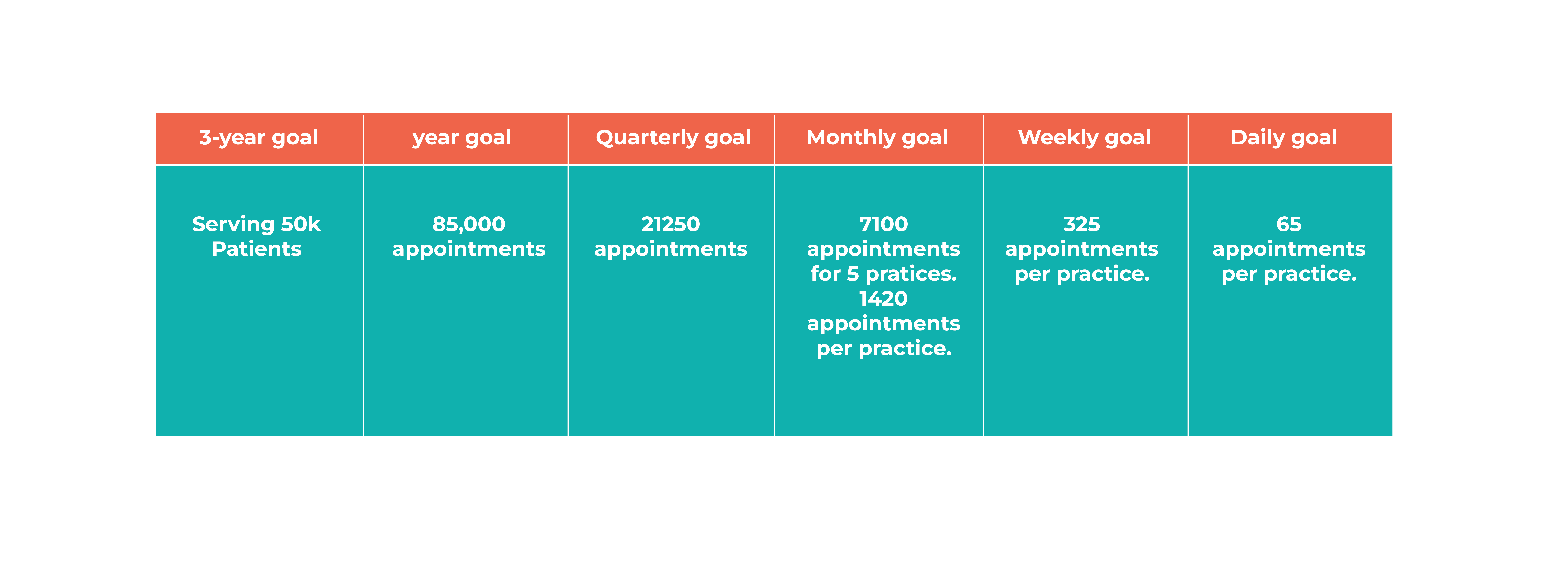
This image illustrates how you can break a goal down into achievable parts over time. This particular goal is for a multi-site practice. The BHAG is growing the practice to “Serving 50k patients in 3 years.” We break this goal down into yearly, quarterly, monthly, weekly and daily goals.

In order to achieve the daily goal of 65 appointments per practice, you can reverse engineer that to see how you’ll achieve it. Do you need more operatories? Do you need to hire more hygienists or associate dentists? Do you need to overhaul your patient management software?

And remember, you don’t want to create a goal that is so big it feels unachievable or so small that you and your team aren’t inspired or challenged. It should feel a little scary but not terrifying. The same goes for your resources. Don’t over-commit your resources or take on something that will cost you or your organization more than you can afford in time or money. That’s why a plan is necessary, it will help you see what is achievable and what might need to wait.

Your Dental Practice Strategic Plan 

Ok, so you’ve got your BHAG. Now what? Let’s look at the exact plan Dr. Jack followed to reach his goal. This is a breakdown of steps you need to take and questions you need to answer for your strategic plan.  

Clarify what you want to achieve in your Dental Practice 

  • You need to be very clear about where you want your practice to end up when you achieve your goal. For instance, you may want to increase the number of patients seen by a certain amount. You will need to know how many patients your team, practice and operations can handle and what the limit is so you can plan to face the challenges that will arise as more patients come into the practice.  

Write down your measurable goals into a well- developed measurable scorecard to be shared with your team  

  • Very similar to the goal chart [see image above] that Jack created for his team, you can break down that goal into increments to see how to reach it, how to delegate the different tasks to your team, and how to create the correct strategies for measuring those goals.  

Set deadlines by breaking down your three-year goals into annual, quarterly, monthly, weekly and daily objectives  

  • One of the most helpful tools I’ve found as a CEO is insisting on my teams keeping a regular meeting cadence. Meetings dedicated to one topic, in this case your BHAG will keep everyone focused on the objectives and cohesive in your strategy.   

Identify and list all the obstacles in your path preventing you from reaching your goals and objectives 

  • Taking the example above, of “increasing patients seen,” you can begin to see where your practice is optimized to receive new patients and where you may face challenges when that number increases. For instance, you may not have a big enough team. You may need to hire an associate or another hygienist. These are the specifics that you will become aware of when you create your plan and look for the obstacles to reaching BHAG.  

List all the resources and capabilities you need to transform those obstacles into growth 

  • These resources may be a more robust CRM (customer relationship management system); You might consider hiring a marketing agency to help you attract, retain and track new patients; with these changes, you may find that your accounting software needs updating. Fleshing out the details of what you already have on hand and where you may need to expand, fund or source new resources or capabilities will save you money and time in the long run.  

Organize your goals into a sequence of priorities  

  • Follow the 80/20 rule which states that 80 percent of your results will come from 20 percent of your activities. It’s important to list them in order of priority and sequence with detailed steps, dates and timelines.

Build an accountability structure for your team 

  • Create a visual accountability chart with specific goals and deadlines for each critical role in your business: most importantly, marketing/sales, operations, and finance. That way, each person knows exactly what part of the BHAG they are responsible for while also knowing the timeline for execution and completion.  

Assign a member of your leadership team to each role. Note that some leaders may have multiple roles 

  • Make sure that each team member knows not just what and when to execute and complete their responsibilities but how they’ll get your vision completed. They will need the proper resources and hands to get the job done. Another quick tip is reviewing that accountability structure in your monthly or quarterly meetings.  

Calculate the investments you need to make to acquire the resources and capabilities listed above  

  • Reaching your BHAG will most likely take a lot of resources including money. You may need to take a business loan, source investors or find revenue in your business. No matter how you source and acquire that money make sure it’s accounted for and earmarked for your BHAG and not simply quotidian funds in your practice. You must keep your eye on the ball.  

The investment you make is a critical part of strategic planning. This investment is not only money, but your time and energy towards the commitment of achieving your BHAG and ultimately realizing your vision for your dental practice.  

Undermining the value of investments and confusing investments with expenses has been the greatest bottleneck to growth for many entrepreneurs and organizations. It’s a good rule of thumb to remember we must invest before we can unlock the benefits of growth.  

Your Dental Practice Strategic Plan Needs A Framework 

Now that you’ve designed your strategic plan, the real work begins… execution. Setting a bold goal, enrolling your team, allocating resources, and committing to the journey ahead can feel intimidating. Big visions tend to do that. But when you know exactly how you’re getting from Point A to Point B, much of that fear fades into focus.

A clear roadmap is essential, but it only works if it’s supported by the right mindset. Belief, discipline, and follow-through are what turn plans into progress. Without them, even the best strategy stays stuck on paper.

That’s why we created the Extraction GPS. This tool helps dental entrepreneurs clarify their values, assess their current reality, and define a clear, intentional path forward. It turns strategic planning into something usable, something you can return to when decisions get hard, momentum slows, or distractions creep in.

Vision plus effort is powerful. Vision plus effort and clarity is unstoppable.

Ready to turn your strategic plan into intentional action?

Leverage a Successful Exit in your Dental Practice: The #1 Tool for Scaling and Exiting

This month we’ve taken a deep dive into scaling your dental practice and doing it successfully. Scaling any business is time-consuming and work intensive. You need the right teams, tools and resources to scale effectively. And there is one tool that stands out among all the others. But this tool is versatile. There are a couple vital ways to use it, so let’s get into it.

In the dynamic landscape of dental practice management, finding effective metrics to guide growth is crucial. One such metric that has gained prominence is EBITDA, or Earnings Before Interest, Taxes, Depreciation, and Amortization. This is also a tool used by PE, banks, and other investing institutions when they are interested in buying a dental practice or organization. So, why not learn how to use this tool to your advantage, even and especially when devising your exit strategy. In this post, we’ll explore how leveraging EBITDA can be a strategic move to scale and even selling your dental practice. 

Understanding EBITDA and How To Use it for your Dental Practice 

EBITDA is a financial indicator that provides a snapshot of a company’s operational performance by excluding certain non-operating expenses. It essentially measures a company’s ability to generate operating income before considering the impact of financing and accounting decisions. Investors use this tool so they can have a clear picture of your short-term operational efficiency, in short, a dental practice’s profitability.

EBITDA essentially isolates earnings in your dental practice to gauge the value and feasibility of your practice as it stands separate from external financial factors.  

  • Earnings: The total revenue (all the money earned from your dental services) minus the cost of services sold (the money spent to offer those services). Also known as net income. 
  • Interest: The cost of debt financing (like loans or credit). 
  • Taxes: The amounts paid to the government can vary and thus are excluded. 
  • Depreciation: The decrease in value of tangible assets (like operatory tools and equipment, office equipment, etc.) over time. 
  • Amortization: Similar to depreciation, but for intangible assets (investor arrangements, real estate, dental offices, etc). 

Why EBITDA Matters for Scaling your Dental Practice 

1. Operational Efficiency:

EBITDA focuses solely on the core operations of your dental practice, making it an effective tool to assess operational efficiency. By identifying areas where costs can be optimized, dental practice entrepreneurs can streamline their operations for better scalability. This is also an incredibly valuable tool for dental practice exit strategies. Having a clear picture of your operational efficiency can put you in a strong negotiating position while giving you better tools for exit strategy planning.

2. Comparative Analysis:

EBITDA allows for easy comparison between organizations in the same industry. This can be invaluable for benchmarking your dental practice against your competitors, identifying areas for improvement, and implementing best practices to foster growth as well as exit strategy analysis.

3. Investor Appeal:

Investors often look at EBITDA as a key metric when evaluating an organization’s financial health. A strong EBITDA margin can make your dental practice more attractive to potential investors, facilitating funding opportunities for expansion and exit. You’re in a much stronger negotiating position when you see what they see and work on increasing your profitability.

You May Also Like This Post:

Steps to Utilize EBITDA for Scaling your Dental Practice 

1. Detailed Financial Analysis of your Practice:

Conduct a thorough analysis of your dental practice’s financial statements to calculate EBITDA. Understand the components and identify any extraordinary items that might distort the true operational performance of your practice. This step cannot be overlooked. In order to get from point A to point B, you’ve got to design a roadmap with the correct data and information.

2. Identify Cost Optimization Opportunities:

Utilize EBITDA as a tool to pinpoint areas where costs can be optimized without compromising operational efficiency. This may involve renegotiating contracts with your vendors, streamlining processes, or investing in upgraded technology for your operatories for greater efficiency. Whether you’re scaling or planning to exit, optimizing your operations will have strong long-term benefits.

3. Strategic Decision-Making:

Armed with a clear understanding of your dental practice’s EBITDA, make strategic decisions aligned with your growth objectives based on your Strategic Plan. This might involve where you choose to open your next location, expanding services perhaps into cosmetic or surgical dentistry, investing in affiliates and partners to increase value, or building your strategic plan for exiting your dental practice organization.

4. Communicate Effectively:

When communicating with stakeholders, including team members, investors, and partners, use EBITDA as a transparent metric to showcase your practice’s financial performance. This fosters trust and confidence in your growth strategy and strategic planning.  

One More Tool for Investing in your Dental Practice  

Leveraging EBITDA can be a game-changer for dental practices aiming to scale or exit successfully. By focusing on operational efficiency, comparative analysis, and strategic decision-making, a dental entrepreneur can use EBITDA as a compass to navigate the path to sustainable growth or a profitable exit.

And don’t overlook mindset. The mindset of a dental entrepreneur cannot be underestimated. You are the driving force behind your vision, mission, and strategic plan. Your passion and clarity are what inspire your team, your vendors, and your partners, they need to trust not just where your practice is headed, but that you have a plan to get there.

If you’re ready to put your vision into action and keep your finger on the pulse of your practice’s value and growth, the next step is simple: track your key performance indicators.
That’s why we created the OPA KPI Tracker, a free, easy-to-use tool designed for dental entrepreneurs. With it, you’ll gain clear insights into the metrics that matter most for scaling, boosting EBITDA, and preparing for a successful exit… whenever that day comes.

Ready to turn clarity into momentum?
Download your free OPA KPI Tracker now and start making every decision data-driven, from growth to exit and every step in between.

The future of dentistry belongs with dentists.