
Growth Measurement

The #1 Astonishing Trick I Used in my Dental Practice Organization to Improve my Leadership and Obliterate Challenges  

Are you doing this in your dental practice? You should. I had my first big lesson as an entrepreneur during the first 6 months of owning my first dental practice. This mistake almost cost me everything. I was in the process of building my first practice and setting the tone for my leadership and team-building when my office manager abruptly quit.  

My Biggest Mistake as a Dental Practice Owner 

She walked out with practically the entire business in her head: the insurance codes, the vendor relationships and everything else I needed to keep our billing on track and money coming in every month.  

Money is the lifeblood of a business. Without capital, your business is paralyzed. I was stuck and we needed answers fast. Unfortunately, my lack of knowledge regarding billing and insurance codes cost me a lot. For 6 months, I ran my practice 5 days a week and then spent my evenings and weekends panicking and trying to learn the billing code system. By the time I had figured out the process, we had passed the deadline to collect our reimbursements for many of our patients. What a costly mistake.  

I was not about to repeat that experience. I spoke with my cousin who was a software engineer, and he created a program that allowed me to track, measure and bill with the correct insurance coding. He got free dental care for life.

This mistake was not due to my lack of knowledge or experience as a dentist. This had nothing to do with learning or mastering dentistry. It had everything to do with being an entrepreneur and business owner. This mistake happened because I didn’t understand how to run a business and it’s a mistake that can happen to any business owner at any level of experience. This mistake was compartmentalizing and not having the proper redundancy any business needs to not have “all of its eggs in one basket” so to speak.  

Improve Leadership in your Dental Practice

Why Every Dental Entrepreneur Needs Systems—Not Just Skill 

I learned the hard way that being a great clinician is not enough to run a thriving dental practice. Most of us never receive any business training before opening our doors. And it’s easy to assume that as long as you know your craft, everything else will fall into place. The reality is, running a business is a completely different skill set.

If you don’t put the right systems in place—from day one—you risk losing not just time and money, but also your peace of mind. My mistake was not building processes that protected my practice from unexpected disruptions. All it took was one person walking out the door to reveal just how vulnerable my business was.

Redundancy isn’t just a buzzword; it’s an insurance policy for your operations. When only one person knows your billing codes, your vendor relationships, or your day-to-day systems, you’re one resignation away from chaos. That’s why dental entrepreneurs need to think like business owners, not just providers. It means documenting everything, cross-training your team, and tracking what matters, so no single point of failure can bring your practice to a halt.

But systems and documentation alone aren’t enough. To really know how your practice is performing, you must be able to measure your progress, spot problems early, and make adjustments in real time. That’s where most practices struggle: they don’t have clear, accessible data on what’s truly moving the business forward.


“You can’t improve what you don’t measure.”
~Peter Drucker

From Chaos to Clarity: Using KPIs to Drive Your Dental Practice

So, what should you actually be measuring?

The answer is KPIs—Key Performance Indicators. KPIs aren’t just numbers on a spreadsheet. They’re the vital signs of your business, telling you where you’re winning, where you’re leaking energy (or money), and where you can grow.

The Best KPIs for Dental Practices

While every office is unique, there are a handful of indicators that always matter:

  • Total In-Office Encounters: How many patients are you actually seeing?
  • New Patient Flow: Are you attracting enough new patients each month?
  • Recall/Recare Visits: Are your patients coming back for preventive care?
  • Walk-In Visits & Telehealth: Are you leveraging every access point?
  • No-Show Rates: How often are appointments going unused?
  • Scheduling Efficiency: Are your appointment slots being maximized?

Tracking these numbers regularly gives you a real-time dashboard for your practice health.

Not all KPIs are created equal. To truly get ahead—and not just react to problems after they happen—you need to understand the difference between lead and lag indicators. Let’s look at the two different types of indicators and how they both function in your practice.

Lead vs. Lag Indicators: What’s the Difference?

Lag indicators are the results—they tell you what happened after the fact. Think: total production, monthly revenue, or collections. They’re important, but by the time you see a drop, the damage may already be done.

Lead indicators are the early warning signs—they track behaviors and processes that predict future outcomes. In a dental practice, this might mean tracking:

  • Number of recall calls made each week
  • Number of new patient appointments scheduled
  • Daily case acceptance rates

By focusing on lead indicators, you can make changes now that improve your lag results later. It’s about being proactive instead of reactive.

Bottom line:
When you combine solid systems with regular KPI tracking, you don’t just survive the unexpected—you grow stronger from it.

Track What Truly Drives Your Dental Practice Forward

If you’ve made it this far, you already know that growth isn’t about chance, it’s about keeping a pulse on what really matters. That’s why we put together our KPI Tracker built specifically for dentists. It’s not fluff; it’s a clear way to monitor the health of your practice across the metrics that actually drive sustainability and scale.

With this tracker, you’ll be able to keep tabs on total in-office encounters, new patient flow, recare visits, walk-ins, telehealth activity, and more. It even factors in scheduling efficiency and no-show rates so you’re not just looking at production—you’re tracking the behaviors that fuel it. Think of it as a dashboard that gives you clarity on where you’re gaining momentum and where small adjustments could unlock growth.

You can grab the KPI Tracker for free today. Along with it, we invite you to book a short call with our team, where we’ll walk you through how to use it effectively in your practice. This way, you’re not just downloading another spreadsheet, you’re setting yourself up with a system to actually measure, understand, and improve.
The 10x Rule: Supercharging Your Dental Practice for Success

The 10x rule is a powerful concept that can take your dental practice to the next level. So, let’s look at how it can work for you.  

Do you think of yourself as an entrepreneur? Do you think of yourself as an investor? If not, why not? You’re a business owner. Your dental practice is a business. For this post, I would like you to see yourself as an investor and see how you can apply the principles discussed below to your dental organization, no matter how big or small it is. Deal?  

The 10x rule has a simple but game-changing premise: Instead of aiming for small, gradual improvements, aim to multiply your efforts and results by 10 times. It’s about setting audacious goals and taking massive actions to achieve them. 

Ultimately though, the 10x approach is really about adopting an investor mindset when you’re optimizing your dental practice. This might be a little challenging to think about at first. As a dental practice owner, you may not think of yourself as an investor; you may not even see your business as scalable. Yes, it can be done, yes, you’ve seen it happen in other practices, but how do you do it yourself? How do you begin to change your thinking and start taking action like an entrepreneur and investor in your practice?  

Changing your mindset is the first step. Learning to apply a growth mindset to your thinking and then to your business is life changing. That shift in mindset can change the trajectory of your life. Are you ready?  

Let’s dive into the deep end of the pool and look at ways that you can begin to see your dental practice as an investment and every dollar you’re spending in your practice as a down payment on that investment.   

The size of your dreams must always exceed your current capacity to achieve them. If your dreams don’t scare you, they’re not big enough.”

~Ellen Johnson Sirleaf, Africa’s first woman president

The 10x Rule for Your Dental Practice 

Yes, 10x is about maximizing your investment but it is also about making sure every dollar you spend is necessary and a reinvestment into your practice. Here’s why, for every unnecessary dollar you spend on your practice, that is one dollar less that you will get back when it’s time to exit. Likewise, for every necessary dollar you spend, that is one more dollar that goes into your pocket when you exit.  

So, the question becomes, how do you invest and reinvest in your practice wisely, so you maximize your investment? And remember, we want big, audacious goals. Jim Collins has a term for this, Big, Hairy, Audacious Goal or BHAG. In his book, Built to Last, Jim talks about setting these goals for yourself to think big and create a plan for long-term success. Big goals are not short-term hops, they are long-term leaps that keep teams focused thereby giving your organization tighter restraints to achieve them.  

Setting 10x Goals for Your Dental Practice 

When setting a goal for your dental practice, the goal, at first glance, might seem almost impossible to achieve. This could mean setting a goal to increase your patient base by 10 times or to generate 10 times the revenue you’re currently making. Keep in mind, these are audacious goals, not modest ones.  

If you want to read firsthand how one dental practice did this, take a look at this case study.

The Power of Massive Action in your Dental Practice 

Once you’ve set your 10x goal, it’s time for massive action. To achieve such an audacious goal, you need to take massive, consistent, and persistent actions. For instance, if your goal is to increase your patient base, you might need to ramp up your marketing efforts, improve your online presence, and offer exceptional patient experiences to attract and retain more clients. All those elements need to be taken into consideration.  

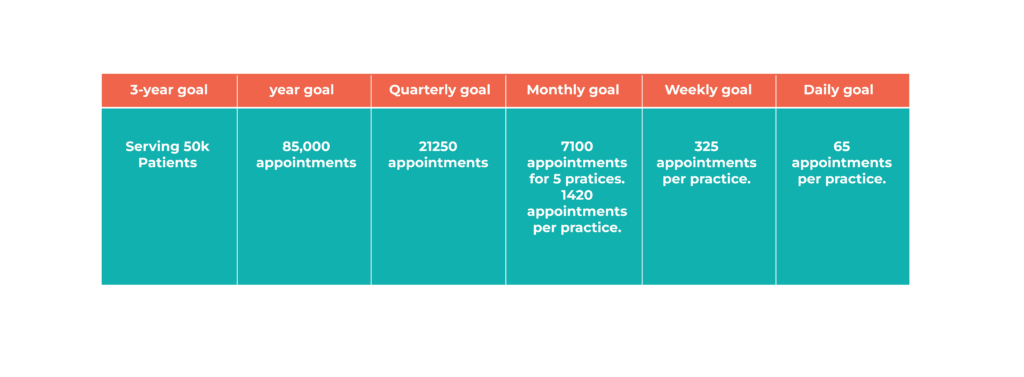
Take a look at the graphic below. This graphic shows the BHAG my partner and president of Optimize Practice Alliance, Dr. Jack Bayraymyan, designed when he was scaling his dental practice organization.

BHAG for your Dental Practice

This looks extremely ambitious, and it was. However, taking a very long view of what Jack wanted to build was the beginning of an incredible and ultimately successful journey. It took this level of vision to accomplish what he eventually accomplished. But he didn’t do it alone.

The first and most vital step after creating your audacious goal, is making sure your team is on board. You need to analyze your team and ensure that everyone is in the right job for them. Next, you need to be confident they are ready, willing and able to fight for your goal as hard as you are going to fight for it. Your team is the most vital component of reaching your goal.  

Embrace Innovation for Your Dental Practice  

To truly leverage the 10x rule, embrace innovation in your practice. Explore technologies and techniques that can help you stand out in the industry. Invest in the latest dental equipment and software that can enhance patient care and streamline your operations. Innovate not just for the sake of it but to drive real results and efficiencies. And remember to do it wisely. If you can find a gently used version of the same technology that is a strong investment because you’re saving money that will eventually end up back in your pocket.  

Digital Transformation in the Dental Industry 

Given your role in optimizing and growing the online presence of your dental organization, digital transformation is a key aspect of implementing the 10x rule. Here are some strategies to consider: 

  • Social Media Presence: Use social media platforms to showcase your practice. Share educational content, patient testimonials, and behind-the-scenes glimpses. Engage with your audience to build a loyal following. 
  • Website Excellence: Ensure your website is user-friendly, informative, and optimized for search engines. A well-structured website is your digital storefront, and it can attract new patients. 
  • Online Scheduling: Implement an online appointment scheduling system to make it convenient for patients to book appointments.
  • Telemedicine: Explore telehealth options for consultations and follow-ups, providing flexibility for patients and expanding your reach. 
  • Patient Reviews: Encourage satisfied patients to leave positive reviews on platforms like Google My Business. Positive reviews can significantly boost your credibility and attract more clients.  

Building a Strong Team 

Remember, having a strong, resilient and cohesive team is the main component of reaching your audacious goal. Communication, transparency, compassionate leadership and the free flow of ideas and feedback are the elements that will help you build a team that will drive your goal. If you have a team that fights for your vision, there is no end to what you can achieve.   

The 10x rule for your dental practice

10X Growth Requires 10X Clarity

The 10X Rule isn’t just about working harder, it’s about directing massive effort toward the right activities. If you want to scale your practice, expand your vision, and take your organization to the next level, you need absolute clarity on what’s actually driving results.

That’s why we created the Optimize KPI Tracker for dental entrepreneurs. This tool helps you focus on the metrics that truly move the needle, so your time, energy, and leadership are applied where they create the greatest impact. When you track the right numbers consistently, you stop guessing and start executing with precision. 10X growth requires discipline, accountability, and visibility. The KPI Tracker gives you all three.

What are you willing to achieve? Now, raise the bar 10x higher than that. You got this.  

How Dental Practices Can Increase Their EBITDA and Why You Should Care: 1 Way to Scale

My Views on EBIDTA  

I’m of the firm belief that using EBIDTA to measure the growth of your dental practice is an essential measurement for its health and success. You never want to overlook the amount of debt you’re taking on and how that is impacting your business. And you don’t want to use EBIDTA as your only measurement of growth. But it is an effective tool if you use it to increase your cost conserving measures and pay attention to your expenses and investments.   

In the short video below, I discuss the importance of increasing your EBIDTA and two methods for increasing it. Not everyone uses this method of measurement in their practice, and I think that is a mistake. If you use it strategically to do monthly deep dives into your must-haves and nice-to-haves, you can get a very good idea of how effective your cost-cutting measures are month over month.  

What is EBIDTA? 

So, what is EBIDTA?  Basically, it’s a way to measure your practice’s overall financial performance by stripping out interest, taxes, depreciation, and amortization –  

Use EBITDA in your Dental Practice

Check out this article on Medium for a more broad context and understanding of EBITDA and how it generally works in business.

Strip out all these other factors and you will have a basic view of your dental practice’s profitability. In my mind, this is an important measurement because it helps you see gauge which cost-cutting measures you take are working. Also, when you strip out all the other numbers, you can focus on the essentials: your operating profitability and your cash flow.  

This is by no means the only way you should measure the success and profitability of your dental practice. You still need to take into account the other factors, but this is another great tool for your entrepreneurial toolbox.  

Increase EBITDA in Your Dental Practice

Why Should Dental Practices Increase Their EBIDTA Margin?  

First, what does increasing your EBIDTA margin mean? Sounds complicated but it simply means lowering your operating expenses in relation to your total revenue. The margin is the percentage of expenses to revenue. So, increasing your monthly EBIDTA margin by 10% means you’re lowering operating expenses or increasing your topline revenue by 10% of your revenue. 

It’s incredibly important for dental practices to be mindful of their operating costs in relation to their revenue. There will be times when your investments far exceed your revenue, but this is the exception rather than the rule. Buying a new piece of digital dental equipment that will increase the value of your offerings, or building out a new software system are essential to practices staying relevant and efficient, but these expenses should be taken in moderation at strategic times.  

Two Methods for Increasing EBIDTA in Your Dental Practice 

When I work with dental entrepreneurs, I like to show them two ways of increasing EBIDTA. These two methods are customized for dental practices and the unique challenges they face in an industry with quite large expenses and investments, especially at the outset of a business venture.  

Learn and Earn –

  • See the advantage of learning while on the job; learning a new piece of equipment; learning a new dental technique; as an investment. By learning while you earn, you continue to develop your skills as a dentist and entrepreneur while increasing the value of your dental practice to the community you serve. The more value you provide raises your production, which attracts more patients, and increases revenue.

Deep-Dive Accounting –

  • On a monthly basis, make sure you take a deep dive into your expenses. Pay close attention to your must-haves, the essentials of running your practice on a daily basis. You cannot run your dental practice without them. But also make sure you pay attention to your “nice-to-haves” and see where you can cut these expenses. You don’t need them. Pay attention to your vendor pricing. I’ve seen prices go up without discussion, get paid, and negatively impact a practice’s valuation without the dentist even knowing it happened. They will enhance your dental practice, but they are not essential to daily operations. The more you manage these expenses the more you increase your EBIDTA margin.  

These two methods increase your operating profit and your EBIDTA margin and that is an attractive measure for you as a dental entrepreneur and anyone looking to invest in your company.  

Turning EBITDA Insight into Action 

Understanding EBITDA is only powerful if you can actively influence it. Increasing EBITDA isn’t about chasing one big change—it’s about consistently improving the operational drivers underneath it: scheduling efficiency, case acceptance, patient retention, provider productivity, and cost control.

That’s why we created the Optimize KPI Tracker for dental entrepreneurs. This tool helps you monitor the metrics that directly impact EBITDA, so you can identify trends early, address inefficiencies, and make smarter decisions with confidence. When you know what’s driving your numbers, you’re no longer guessing, you’re leading strategically.

Ready to take control of your practice’s profitability and long-term value?

#1 Rule of Successful Dental Practice Owners: Measure What Matters 

Do you measure what truly matters in your dental practice? Nearly every conversation I have with a fellow dentist-entrepreneur circles around how to know your investment and time is working, ‘how do you know that you’re actually growing your dental practice?’ 

You Can’t Improve What you Do Not Measure

Common sense tells us that in order to keep improving you must keep examining the results of what you’re doing. What is the point of doing a tremendous amount of work unless you’re going to review it to see what has been effective and what has been a waste of time? 

“In God we trust, all others bring data.”

-W. Edwards Deming

Reading a slew of reviews about a business who consistently makes incredible hamburgers but their fries are always soggy is literally reading the lagging indicators of a business that refuses to accept feedback and examine its protocols to address what is working and what is not. Reviews are one way to gain insight into what’s working in your business and what’s not working. They are also a look back into the near past: one person’s recent experience at that one hamburger joint. Make sense?

Here’s What to Measure in your Dental Practice

So, how do you measure and what do you measure? Two vitally important questions every business needs to ask and answer constantly and consistently.  

In the case of dental patient treatment plan acceptance, patient nurturing and dental patient experience, not all actions are created equal. Some of our actions have a greater impact on our environment than others and it’s a good idea to know which ones have a greater impact and which ones have a weaker impact.  

Lead Measure Vs. Lag Measure

First, let’s define some terms. Lead measures or lead indicators help you predict which actions might successful and which might not, in other words, what to keep doing to keep getting the same successful results.  

A lag measure or lag indicator, measures your wildly successful goal with results that have already passed like profit, revenue, and patient satisfaction. They are a little harder to gauge because the results are correlated to actions taken in the past.  

In my book Extraction: The Surprising New Formula to Systemize, Scale and Sell Your Business, I breakdown different forms of measurement and the importance measuring growth and goal achievement play in your leadership role. Let’s look at three measurable areas of your practice here.  

Dental Practice Revenue Growth

  • Leading Indicator: The leading indicator here is the Number of Qualified Patient Leads. By measuring the number of qualified leads generated, your business can predict future sales growth. In a dental practice, your qualified leads are patients who call for an appointment—for a service you can provide with a payer you accept. If the number of qualified leads is increasing, it’s likely that sales growth will follow. If your qualified leads are decreasing this is an area that you want to pay attention to with your team to decide why they are decreasing and what can be done to stop and reverse the trend, essentially get ahead of the ‘problem’ before it becomes one.  
  • Lagging Indicator: Dental Practice Production or Revenue. Production or revenue is a lagging indicator because it shows the results of past sales efforts. As we know, production in your dental practice doesn’t happen if the patient doesn’t show up, accept the treatment plan, and ultimately pay for the dental care you delivered. After sales have been made, revenue is generated, but this data is historical and cannot be used to predict future sales growth. It can help you look back and evaluate what you and/or your team did to increase revenue or the reverse: review what you did that possibly decreased revenue.  

Safety in Your Dental Practice

  • Leading Indicator: Number of Safety Training Hours. By measuring the number of safety training hours completed by employees, including HIPAA and OSHA trainings, a business can predict the likelihood of workplace accidents. There is a documented correlation of safety in the workplace to awareness of rules, laws, regulations and best practices. If the number of safety training hours is increasing, it’s likely that the number of accidents will decrease in the future. 
  • Lagging Indicator: Number of Workplace Accidents. Workplace accidents are a lagging indicator because they represent past events that have already occurred. By the time an accident is recorded, it’s too late to prevent it from happening. But it’s not too late to review protocols, training hours and best practices to ensure accidents decrease and awareness of safety protocols are top of mind for your employees.  

Managing Employee Turnover in Your Dental Practice

  • Leading Indicator: Employee Engagement. By measuring your employee engagement through surveys, anonymous feedback systems, communications and strong morale engagement, your business can predict your future turnover rates. If your employee engagement is low, it’s likely that turnover rates will increase in the future. 
  • Lagging Indicator: Employee Turnover Rate. Your employee turnover rate is a lagging indicator because it shows the results of your past employee retention efforts. After employees have left, turnover rates can be calculated, but this data is historical and cannot be used to predict future turnover rates. However, if your turnover rate is high, you can take a look at your employee engagement protocols to see what is lacking and where you can improve employee engagement.  
What Type of Growth is Expected in My Dental Practice?

The Measurement of Growth is A Measure of Leadership

These are just a few examples of how using and measuring your leading and lagging indicators can improve so many areas of your dental practice. The key takeaway is that leading indicators can be used to predict future outcomes, while lagging indicators show the results of past actions. By tracking both leading and lagging indicators, you can better understand how your actions, decisions and the actions of your teams affect performance so you can make more informed decisions about future strategy. 

The role of a leader is not just to delegate, guide and grow, it is also to measure so you can continue to improve on what has come before. If you’re working with a strategic plan in order to scale your practice, how will you know when to buy your second practice? Is it simply when you’ve socked away enough money or is it when your key performance indicators show that, not only are you financially ready to buy but it’s also the right economic environment to buy?  

Mastering Dental Practice Entrepreneurship

Successful dental practice owners don’t grow by guesswork, they grow by measuring what truly matters. If you’re ready to assess the real health of your practice and make confident, data-driven decisions, the next step is putting the right metrics in front of you.

That’s why we created our KPI Tracker, built specifically for dental entrepreneurs. This tool helps you monitor the key indicators that drive growth, profitability, and sustainability, so you can spot trends early, identify opportunities, and lead your team with clarity.

If you’re ready to stop relying on assumptions and start leading with insight, this tracker gives you a simple, actionable way to stay focused on what moves the needle.

Ready to measure what matters most?