
Optimize Practice Alliance

Rural Health Transformation Program Readiness Checklist: 9 Areas That Make the RHTP Achievable

Here is your Rural Health Transformation Program readiness checklist. The Rural Health Transformation Program is a once-in-a-generation opportunity to reshape rural care. But the money alone won’t create impact, your readiness will

Have you asked yourself, “How prepared are we to transform our health center when the funds arrive?” 

The RHTP is a five-year, $50 billion federal investment designed to help states transform rural health care delivery – improving access, quality, and outcomes through innovation, workforce, and technology. States submit transformation plans to CMS and, if approved, will receive substantial funding from 2026 to 2030.

That means your state is (or soon will be) designing RHTP-funded opportunities. Health centers that show up with clear, grounded, implementation-ready plans will be first in line. 

This post is not a breakdown of every line in the statute. It’s a Rural Health Transformation Program readiness checklist for CEOs, CMOs, CDOs, and operational leaders who don’t just want to “chase a pot of money,” but actually use those dollars to transform care. 

Use these questions with your leadership team. If too many answers are “I’m not sure” or “we haven’t really talked about that,” you’re not ready yet and that’s exactly where the work needs to start. 
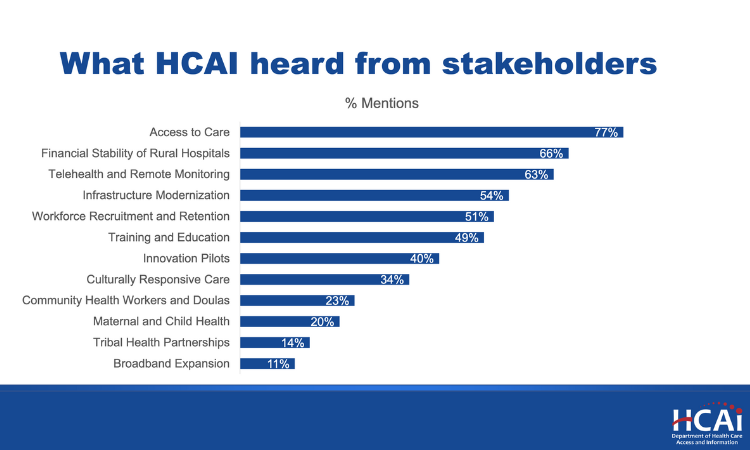
Rural Health Transformation Program readiness
Rural Health Transformation Program readiness and what HCAI heard from you.

Here is your Rural Health Transformation Program Readiness Checklist.

Let’s get ready together.

1. Have we defined our vision across the four RHTP strategic goals? 

CMS and federal guidance frame the RHTP around several key areas, here are the four big themes:

  • Sustainable access 
  • Workforce development 
  • Innovative care 
  • Tech innovation 

Before you draft a single paragraph of a proposal, ask: 

  • If we had meaningful new funding, what would “sustainable access” actually look like in our service area? 
    More appointments per day? A stronger dental program? Fewer no-shows? Extended hours? 
  • What’s our long-term vision for workforce development? 
    Do we want defined career ladders, better onboarding, opportunities for growth, or all of the above? 
  • What innovative care models do we want to build or scale? 
    School-based care, mobile clinics, embedded dental in medical, integrated behavioral health, a telehealth program? 
  • How do we want technology to change daily life for our clinicians and patients, not just our IT budget? 
    Think: easier documentation, better decision support, tighter medical-dental integration, more proactive outreach, second-opinion tools. 

If you can’t articulate even a rough vision in each of these areas, your RHTP plan will end up being a string of buzzwords instead of a transformation roadmap. 

2. Do we have a clear strategy for each of the three “on-the-ground” pillars? 

Underneath those four federal goals, health centers will actually execute in three practical pillars: 

  1. Transformative care models 
  1. Technology and tools 
  1. Workforce development and change management 

Ask yourself the following: 

  • Transformative care models: 
    • Where are the biggest gaps today between what our community needs and what our current model can deliver
    • How will we break down silos between medical and dental health
    • If we want to expand dental access, what does true medical–dental integration look like in our clinics? 
  • Technology and tools: 
    • Which tools actually move the needle on access, quality, and provider experience and which are shiny objects? 
    • Are we prioritizing clinical second-opinion tools, ambient note-taking, telehealth, and data infrastructure that support real care redesign? 
  • Workforce and change management: 
    • Who will champion these changes internally? 
    • How will we support staff through workflow changes, new tech, and new care models – instead of just “dumping another project” on them? 

If your answers are vague, that’s a sign you’re not just “under-documented” – you’re under-decided. 

3. Do we understand what our state is actually prioritizing? 

RHTP is federal, but applications and implementation are state-driven. States submit a Rural Health Transformation Plan to CMS, then design their own program priorities and processes.

Key questions: 

  • Do we know our state’s RHTP timeline, NOFO, and stated priorities? 
    • Which populations, service lines, and geographies is your state emphasizing? 
    • Are there specific expectations around behavioral health, maternal health, telehealth, or integration? 
  • Do we know how funds will flow in our state? 
    • Will health centers apply directly to the state? 
    • Are there regional hub-and-spoke models or consortia being encouraged? 
  • Have we already engaged with our state on the design? 
    • Have we responded to surveys, listening sessions, or RFIs? 
    • Have we clarified how oral health and dental integration fit into the state’s larger strategy? 

If your team is still saying, “We’ll see what the state rolls out and then react,” you’re already behind. Strategically prepared health centers are co-shaping the agenda, not just applying into it. 

4. Are we fixing access with strategy, not just square footage? 

One of RHTP’s core aims is to improve access to care in rural communities, not just keep buildings open.

Before you ask for new space, new chairs, or a new site, ask: 

  • Have we maxed out access with the space we already have? 
  • Are scheduling templates optimized? 
  • At Optimize Practice Alliance, we’ve used scheduling template redesign to help health centers move from the usual 8–13 encounters per provider per day to 50%+ more patient encounters. At Centro Medico, those changes translated into dramatically expanded access with the same number of operatories and staff. 
  • Are hygiene, restorative, and medical schedules aligned to minimize bottlenecks? 
  • Do we consistently run on time, or do we lose capacity to chaos? 
  • Do we have a plan to expand access through better systems, not only more bricks and mortar? 
  • Standardized workflows 
  • Smarter recall and re-care systems 
  • Flexible team-based care models 
  • Can we quantify the access lift of our proposed changes? 
  • e.g., “With these changes, we can safely increase dental encounters by X% using existing operatories and staff.” 

RHTP reviewers will be looking for transformational leverage, not “more of the same, but more expensive.” 

5. What is our recruitment and retention strategy, beyond “we hope people stay?”  

RHTP explicitly calls out workforce development and retention as a priority.  

So: 

  • Do we have clearly defined career pathways and levels for clinical and operational roles? 
  • Can an entry-level team member see a path to becoming a lead, manager, or advanced clinical role? 
  • How strong is our onboarding and training? 
  • Can we reliably take a new grad provider from “brand new” to “highly productive and confident” within a defined timeframe? 
  • We also help health centers build structured clinical development pathways so new-grad providers don’t stay “new” for long. Using a combination of simulation-based training, case review, and progressive skill-building, we’ve supported clinicians in going from fresh graduates to confident, efficient providers who can handle advanced procedures with consistency. This kind of structured development doesn’t just improve clinical performance, it strengthens retention and builds long-term workforce stability. 
  • Do we understand why people leave us? 
  • Are we tracking turnover data and reasons systematically? 
  • Do we know where burnout is highest and why? 
  • If we used RHTP dollars for workforce, would it be one-time bonuses, or structural change? 
  • Training pipelines, professional development, career ladders, and leadership development are far more sustainable uses of funds than short-term pay bumps. 

If your only workforce lever is “pay them more,” you’re leaving a lot of transformation and long-term stability – on the table. 

6. Do we actually have an AI strategy, or just a list of tools we’ve heard about? 

RHTP strongly encourages technology-driven, data-driven solutions that support prevention, chronic disease management, and better outcomes.

For most health centers, that should include an intentional approach to AI. Ask: 

  • Who owns AI strategy in our organization? 
  • Do we have an AI governance group or at least a designated champion? 
  • Do we know what we’re comfortable with and what we’re not? 
  • Are we piloting tools that actually free up clinical time and improve quality? 
  • Ambient note-taking to give clinicians time back 
  • Clinical second-opinion tools (e.g., radiograph analysis, risk scoring, lab decision support) 
  • Predictive outreach to identify high-risk patients earlier 
  • How will we evaluate AI tools? 
  • Impact on access, quality, provider experience, and equity 
  • Data privacy and security 
  • Alignment with our state’s RHTP priorities 

RHTP is a rare chance to build a responsible AI foundation instead of reacting piecemeal to vendor pitches. Optimize Practice Alliance is leading the charge when it comes to AI in dental care. Our AI rollouts routinely give dentists back 26 minutes a day by wiping out the bulk of their documentation burden. And because our CEO, Josh Gwinn, is the founding president of the Denver chapter of AAIA Global, we’re not guessing at where AI is going, we’re helping shape the standards for safe, effective clinical use. 

7. How ready are we for change management, not just project management? 

Most failed “transformations” don’t die because the idea was bad. They die because nobody planned for the human side. 

Ask: 

  • Who is our internal change leader for RHTP? 
  • Is there a cross-functional group (medical, dental, behavioral health, operations, finance, IT) that meets regularly? 
  • How will we communicate changes to staff and patients? 
  • Do we have a plan for training, feedback loops, and iterating without burning people out? 
  • What will success look like in year 1, year 3, and year 5? 
  • Are we setting realistic milestones – not just “Everything will be transformed by 2030”? 

If your RHTP plan doesn’t have a change-management backbone, the best strategy in the world will stall in the day-to-day. 

8. Can we show sustainability once the grant dollars sunset? 

States and CMS will be looking hard at whether proposed projects will survive beyond the funding window.

Your team should be able to answer: 

  • What happens when RHTP funding ends? 
  • Does the project collapse, or does it become self-sustaining through improved revenue, cost savings, or other funding streams? 
  • Do we have a financial model that ties clinical transformation to financial stability? 
  • For example: more completed treatment plans, higher kept-appointment rates, improved coding and documentation, reduced avoidable ED visits. 
  • Are we avoiding uses of funds that can’t be maintained? 
  • e.g., staffing models that only work if grant dollars are permanent. 

If you can’t show a credible path to sustainability, you’re not fully prepared, no matter how strong your narrative is. 

9. Where are we already strong and who are the right partners for the rest? 

Finally, a simple but important set of questions: 

  • What do we already do well that RHTP can help us scale? 
  • Maybe it’s a small but successful mobile-based dental program, or an integrated medical-dental workflow in one clinic. 
  • Where do we openly need outside expertise? 
  • Practice operations and scheduling redesign 
  • Our Practice Optimization Processtm is a strategic, proven framework with a track record of transforming underperforming clinics into high-efficiency, high-access care teams. It’s the same system we’ve used to redesign workflows, tighten scheduling templates, and unlock dramatic gains in patient encounters, without adding staff or operatories. 
  • Dental and medical-dental integration 
  • We help health centers stand up fully integrated medical–dental care models that bring preventive dental evaluations directly into primary care: no extra chairs, no added complexity. This integrated approach consistently uncovers hidden oral-health needs, drives earlier intervention, and opens entirely new access points inside the existing footprint. It’s one of the fastest, most sustainable ways to expand care without expanding your building. 
  • AI governance and clinical second-opinion tools 
  • Workforce pathways and training 
  • Who are we going to call in before we write the proposal? 
  • Implementation partners should be at the design table, not just in the budget appendix. 

Optimize Practice Alliance works with FQHCs and community health centers across the country on exactly these questions, from building sustainable dental programs and integrated care models to designing AI-enabled, clinician-friendly workflows. RHTP is new, but the fundamentals of transformation are not. 

Ready to get serious about RHTP readiness? 

If reading this raised more questions than answers, that’s a good sign. It means you’re thinking at the right level. 

Here’s a simple next step: 

Pull this list of questions into your next leadership meeting.  Have your team rate each area (Sustainable Access, Workforce, Innovative Care, Tech & AI, Change Management, Sustainability) as: 

  • We’re clear and ready 
  • We’ve started, but it’s shaky 
  • We haven’t really tackled this yet 

Rural Health Transformation Program Readiness for 2026

Ready to move from awareness to readiness?
Our RHTP Guide for Health Center Executives was created to help leaders translate RHTP expectations into operational clarity, so your organization is positioned not just to access funding, but to execute meaningful, sustainable transformation.

Because the real question isn’t “Can we get the money?”
It’s “Are our systems, operations, and leadership aligned to deliver on what the RHTP requires?”

Download the RHTP Guide for Health Center Executives to pressure-test your readiness, identify where optimization will matter most, and ensure your health center is prepared for what’s ahead, before the next bend in the road.
The Future of AI in Dentistry: How to Seize the Power of ChatGPT-5 to Scale Smarter, a Conversation with Joshua Gwinn

“Dentist Near Me” Clicks Now $30+: There’s a Better Way to Grow

If you’re a dental entrepreneur and you’ve been running Google Ads lately, you’ve probably felt the pinch. The average Dentist Near Me advertising costs have skyrocketed, often $30 or more per click. That’s $30 spent every time someone simply visits your site… before they call, book, or even decide if you’re the right fit.


For many dental entrepreneurs, this is becoming an unsustainable way to grow. Paid ads can be a great tool in a balanced marketing mix, but when costs climb and competition spikes, it’s time to rethink your strategy.

The problem with over-relying on ads:

  • They stop working the moment you stop paying.
  • You’re competing with every other practice in your market.
  • Costs increase year after year, cutting into profit margins.

The better way? Own your influence

Instead of paying for every click, invest in organic, repeatable growth systems, like building a strong social media presence, leveraging short-form video, and creating content that keeps you top-of-mind in your community. That’s where Bizzy, our proven social media training program for dental entrepreneurs, comes in.

Bizzy was created by Dr. Ben Winters, known to millions on social media as The Bentist. He’s one of the most recognized dentists online, with over 20+ million followers across TikTok, Instagram, and YouTube. He didn’t just crack the code on creating viral dental content, he built a repeatable system for turning that attention into real-world patient growth. After seeing how many orthodontists and dental entrepreneurs were struggling to stand out online, Dr. Winters created Bizzy to teach those same strategies to the dental community. His mission is simple: empower dentists to own their influence, attract patients organically, and build thriving practices through the power of short-form video.

Bizzy teaches you and your team how to create authentic, engaging videos that drive awareness, attract patients, and strengthen your brand, without paying for every interaction. You’ll learn to turn your practice into a content powerhouse that works for you 24/7, for a fraction of the cost of paid ads.

The bottom Line: No More “Dentist Near Me” Advertising Costs

Rising Dentist Near Me advertising costs are a sign: it’s time to build marketing assets that are yours to keep. Paid clicks may come and go, but organic influence lasts. With Bizzy, you’ll

  • Master your brand voice, so your content stands out
  • Educate your prospective patients before they ever walk in the door
  • Build a loyal following that already trusts your expertise

The result? Stronger brand loyalty, higher patient compliance, and a marketing engine that grows your practice without draining your budget.

Ready to take control of your growth without feeding the ad machine? Get Bizzy and then…get busy!

PRESS RELEASE: Optimize Practice Alliance Announces Strategic Partnership with RipeGlobal to Accelerate Clinical Excellence and Practice Growth 

DENVER, CO – July 29th, 2025– Optimize Practice Alliance is proud to announce a strategic partnership with RipeGlobal, the leading digital training platform for dentists seeking to rapidly advance their clinical skills. Together, we are on a mission to help dental entrepreneurs build stronger practices by empowering their associate dentists with the skills, confidence, and clinical experience they need to thrive. 

This partnership is a natural fit. Optimize Practice Alliance is dedicated to helping dental entrepreneurs grow, scale, and exit their practices with maximum efficiency, while RipeGlobal is transforming clinical education through immersive, cloud-based, real-world training designed to make dentists proficient faster once they leave dental school. 

What This Means for the Dental Community 

Through this partnership, dental entrepreneurs, DSOs, and Federally Qualified Health Centers (FQHCs) will gain access to an innovative framework that benefits every stage of the dental journey: 

  • Rapid clinical upskilling for associates and new graduates 
  • Increased retention and performance across private practices 
  • Clear, performance-based pathways to ownership and career growth 
  • Operational systems that reduce the mentorship burden on senior clinicians 
  • A scalable framework to support sustainable, successful dental businesses 

“Most practice owners and FQHC leaders struggle with getting new graduates clinically up to speed fast enough to keep up with patient demand,” said Josh Gwinn, CEO of Optimize Practice Alliance. “RipeGlobal’s digital training model is a game-changer, it closes that skills gap quickly, making associate dentists more confident and productive, which in turn drives practice growth.” 

A Win for Private Practices and FQHCs 

This collaboration is especially impactful for FQHCs, where many associate dentists are hired straight out of dental school. By leveraging RipeGlobal’s training, FQHCs can accelerate new dentists’ proficiency, improving patient care while helping health centers expand access to much-needed dental services. 

Building Stronger Practices and Lasting Legacies 

Optimize Practice Alliance and RipeGlobal share a commitment to creating meaningful, long-term success for dentists, whether they are new graduates, seasoned clinicians, or entrepreneurial practice owners. Together, we are providing the tools and strategies to build better clinical teams, stronger practices, and lasting professional legacies. 

About Optimize Practice Alliance 

Optimize Practice Alliance helps dental entrepreneurs achieve financial freedom by providing proven systems for marketing, operations, and leadership. We help dentists grow, scale, and exit their practices with clarity and confidence. 

About RipeGlobal 

RipeGlobal is a revolutionary cloud-based training platform designed to accelerate the learning curve for dentists worldwide. Its immersive clinical education equips new graduates and associates with real-world skills, dramatically reducing the time it takes to become a confident, proficient clinician. 

For more information, visit OptimizePS.com or RipeGlobal.com

Media Contact 

Rebecca Balliet 
VP of Strategy 
Optimize Practice Alliance 
rebecca.balliet@optimizeps.com 

PRESS RELEASE: Henry Schein One Unveils The Catalyst Index, a Look into Dentistry’s Top 10%

AMERICAN FORK, Utah–(BUSINESS WIRE)–Henry Schein One today announced the launch of The 2025 Catalyst Index, its exclusive report offering dental practices an unparalleled view into the strategies transforming performance across the industry. Built on years of trusted benchmarking and informed by Henry Schein One’s most connected platform, the fourth annual report, The Catalyst Index, raises the bar by revealing the specific actions that distinguish the top 10% of DSOs and private practices.

“We’re at a turning point in dentistry,” said Dr. Ryan Hungate, Chief Clinical and Strategy Officer, Henry Schein One. “Practices can no longer afford to operate without clear insight into what separates top performers. The Catalyst Index gives them that competitive edge. It’s like peeking behind the curtain at how the best practices operate.”

Transforming Care Through Insights

According to the report, top-performing practices significantly outpace their peers in both patient growth and revenue, even while seeing fewer patients than the previous year.

Top performers are focused on simplifying the full patient experience, including faster appointment access, streamlined forms, improved billing clarity, and flexible scheduling. This contributed to stronger patient retention, better reviews, and greater acceptance of care plans. The most profitable practices are also operating more efficiently as a team.

The takeaway is clear: there’s a huge opportunity here. Here are just a few of the insights uncovered in the full report:

  • Nearly 60% of patients decline care due to ineffective education, lack of pricing clarity, and a frustrating overall experience.
  • Month-long appointment lead times are common among average practices, while top performers prioritize access for new and emergency patients.
  • Patient experience directly impacts performance. Practices that offer online forms, transparent billing, and flexible scheduling see stronger retention and treatment acceptance.
  • Chairside revenue potential remains underutilized. On average, daily gross production is nearly four times lower than that of the top 10%.

“If you’re average, get mad and fix it. The amount of production being left on the table is mind-boggling,” said Joshua Gwinn, CEO, Optimize Practice Alliance. “The top 10 percent are absolutely crushing it, and it’s not a secret why. They follow a process, build the team, execute, hold people accountable, and analyze their data. If you don’t do that, you’ll stay average or below.”

Driven by Data, Designed for Care

Henry Schein One’s annual benchmarking reports continue to empower thousands of dental practices to measure their performance, identify opportunities, and chart paths for growth. The Catalyst Index expands on previous reports by not only benchmarking results but also highlighting the concrete strategies that drive success.

With its deep commitment to creating the most connected platform in dentistry, Henry Schein One continues to help practices automate and simplify workflows, secure patient data, and drive profitability, delivering technology that allows clinicians to refocus on what matters most: patient care.

“Being recognized as part of the top 10% is a reflection of the steps we’ve taken to simplify and strengthen how we run our organization,” said Evelyn Lahiji, COO, Children’s Dental Fun Zone. “Centralized billing and AI-supported diagnostics have made a big difference for our team and our patients. The Catalyst Index does a great job of showing what’s possible, and I think it will give other practices a practical way to evaluate what’s working and where they can improve.”

The Catalyst Index is Now Available

Click here to explore the full Catalyst Index and find out where your practice stands.

About Henry Schein One

Henry Schein One, a leader in dental software, empowers dentists to focus on patient care, ensuring practice success.

With its simple and integrated software, practices are finally more seamless, more efficient, and more profitable—meaning patients and practitioners are happier. With comprehensive solutions: demand generation, patient experience, practice management, revenue management, dental analytics, and clinical workflow, dental practices will be running smoother than ever before.

Henry Schein One, LLC, is a joint venture between Henry Schein, Inc. (Nasdaq: HSIC) and Internet Brands. The company’s portfolio of leading brands includes Dentrix®, Dentrix Ascend®, Jarvis Analytics™, TechCentral™, Lighthouse360+, and DentalPlans.com®, along with solutions offered through international companies, including Dentally and Software of Excellence, among others. For a full list of our brands, please visit our website or connect with us on LinkedIn.

Contacts

Claire Barbier, Communications Manager, Henry Schein One, Claire.barbier@henryscheinone.com, (631) 559-2942

Optimize Practice Alliance Joins forces with Dr. Ben Winters AKA the Bentist and Bizzy for Social Media

OPTIMIZE PRACTICE ALLIANCE PARTNERS WITH DR. BEN WINTERS AKA THE BENTIST: REVOLUTIONIZING SOCIAL MEDIA TRAINING FOR DENTAL PROFESSIONALS

DENVER, CO (December 24, 2024) –Optimize Practice Alliance is excited to announce its partnership with Bizzy, the groundbreaking social media training course created by Dr. Ben Winters. Widely known as The Bentist on social media, Dr. Winters has amassed over 18 Million followers across TikTok, Instagram and YouTube for his videos educating the public on dentistry and orthodontics. The collaboration between Optimize and Bizzy brings a unique, psychology-based approach to social media marketing specifically tailored for dentists and dental entrepreneurs. 

Key highlights of this partnership include: 

  1. Timeless Psychological Principles: Unlike typical “point and click” courses, Bizzy focuses on human psychology, ensuring its strategies remain effective regardless of platform changes. This approach provides dental professionals with enduring skills to connect with their audience.
  2. Dental-Specific Content: Bizzy is the only social media training course designed exclusively for dentists and dental entrepreneurs. It addresses the unique challenges and opportunities within the dental industry, making it an invaluable resource for professionals looking to enhance their online presence.
  3. Proven Success Model: Dr. Winters, with over 1 BILLION views across his social media platforms, shares the exact strategies that propelled his orthodontic practice to incredible success. Participants gain insights from his vast accomplishments as an online influencer as he instructs them how it’s done.

“This partnership with Bizzy offers our members an unparalleled opportunity to master social media marketing in a way that’s both effective and authentic to their profession,” states Josh Gwinn, CEO of Optimize Practice Alliance. “Dr. Winters’ expertise in combining dental knowledge with social media savvy is truly revolutionary for our industry.” 

The Bizzy course covers a range of topics, including content creation, audience engagement, and analytics, all tailored to the dental field. Participants will learn how to create impactful social media strategies that resonate with their target audiences, ultimately driving practice growth and patient loyalty. 

For more information about this partnership and how to enroll in Bizzy courses, please visit our website or contact Jon Grossman, Director of Business Development for Optimize Practice Alliance. 

ABOUT BIZZY: 

Developed by Dr. Ben Winters, The Bentist, Bizzy is a social media learning course designed specifically for dental professionals and entrepreneurs, helping them harness the power of social media to connect with patients and grow their practices. 

ABOUT OPTIMIZE PRACTICE ALLIANCE:

Optimize Practice Alliance is a full-service consulting and dental partnership organization with the sole purpose of helping dentists and their teams clarify and then execute their own specific meaningful vision for growing and scaling, building or joining a platform, or securing investment.

Media Contact:
Jessica Dean
Content and Marketing Manager
jessica.dean@optimizeps.com

Business Contact:
Jon Grossman
Director of Business Development
jon.grossman@optimizeps.com