
rural health

RHTP Technology Funding: 5 Smart Ways FQHCs Can Position AI as a Strategic Investment

The Rural Health Transformation Program (RHTP) represents one of the most significant federal investments in rural health in decades: with $50 billion allocated to states over the next five years to modernize rural healthcare systems, expand access, strengthen workforce capacity, and promote innovative practices.

For FQHC leaders, RHTP technology funding is most effective when AI and technology are positioned around five core strategies that states and CMS are already prioritizing.

As FQHCs prepare to engage with their state’s implementation of RHTP funding, one area that holds both substantial risk and opportunity is RHTP technology funding, specifically how health centers plan for, implement, and frame technology and AI solutions within broader transformation strategies. 

This blog explores how FQHCs should think about technology strategy in the RHTP era, what kinds of tech initiatives align with funding priorities, and how to effectively position those initiatives so they’re seen as essential building blocks in advancing access, workforce capacity, and care quality. 

Position AI as an Access-Expansion Strategy

States are approaching RHTP with broad strategies that address access, workforce, prevention, and sustainable systems of care. Among the core strategic goals identified by the Centers for Medicare & Medicaid Services (CMS) are expanding access in rural communities, improving care quality, supporting workforce development, and fostering innovative care models, explicitly including technology innovation.

This is key: RHTP technology funding isn’t primarily about buying software or hardware. It’s about technology as an enabler of system-wide transformation. For health centers, that means thinking beyond features and toward how technology reshapes care delivery, team performance, and patient access. 

In state RHTP plans submitted in late 2025, many include proposals to enhance broadband access, telehealth capacity, AI-enabled services, and digital infrastructure, all with the goal of strengthening access and outcomes for rural residents.

For FQHCs, this translates into a dual challenge: 

  1. Choosing technology that genuinely expands capacity and access 
  2. Writing plans that explain technology in terms of measurable impact, not just adoption 

Tie AI Investments to Workforce Retention and Burnout Reduction

To align with RHTP’s technology funding priorities, FQHCs and their partners need to understand how states are framing their applications and how CMS evaluates those plans. 

Here are the principles emerging as central to RHTP technology funding: 

1. Technology Must Support Expanded Access 

One key expectation in RHTP plans is that technology investments contribute directly to expanded access for rural patients, not simply upgrade infrastructure. Examples include AI driven tools that reduce clinician burden or telehealth platforms that make specialty care more accessible in remote regions. 

For example, North Carolina’s RHTP implementation includes investments in technology aimed at enhancing access to mental health care and expanded broadband connectivity, explicitly calling out AI and expanded tech capacity as part of the strategy to strengthen rural networks.

For FQHCs, this means showing how technology reduces barriers to care and expands points of access (e.g., virtual visits, digital follow-ups), not just how it improves internal processes. 

2. Technology Should Reinforce Workforce Capacity 

Workforce shortages continue to challenge rural care, especially when FQHCs aim to deliver more with fewer resources. RHTP explicitly prioritizes workforce development and retention alongside technology.

This presents a compelling narrative opportunity for FQHCs: frame technology as a workforce multiplier, not a replacement. Tools like AI-assisted documentation, ambient note-taking, and clinical decision support can reduce clinician burden and prevent burnout, helping retain staff and provide more time for patient care. 

When these tools are discussed as part of a workforce strategy, rather than standalone tech projects, they become more compelling within RHTP proposals. 

3. Technology Must Be Implementable and Sustainable 

Funding applications that highlight realistic implementation strategies tend to fare better. RHTP reviewers (at both state and federal levels) want to see that health centers understand not only the what of their technology upgrades, but the how: including governance, workflow integration, staff training, and measurable outcomes. 

This aligns with the broader strategic goals of RHTP that emphasize sustainable access and efficiency.

Show a Phased, Operational Rollout for AI Adoption 

To make technology fundable under the RHTP framework, FQHCs should focus on solutions that tie directly to measurable access, outcomes, and workforce objectives: 

AI-Enabled Clinical Support 

Tools that provide AI second opinions for diagnostics, such as radiographic review support, can enhance clinical decision-making and quality, particularly in settings where specialist access is limited. 

Ambient Documentation Tools 

AI note-taking tools that reduce time spent on documentation can save clinicians an average of 20–30 minutes a day, allowing more time for patient care and reducing burnout. 

Front-Office AI Tools 

AI receptionist or scheduling tools that smooth patient intake, appointment reminders, and navigation support can improve throughput, enhance patient experience, and reduce no-shows, directly contributing to expanded access. 

Connected Care and Telehealth Platforms 

Systems that support remote care visits, specialist consultations, and care coordination across sites bolster access, especially for patients who face geographic barriers. 

Importantly, RHTP doesn’t reward technology deployment in isolation. The most robust proposals clearly: 

  • Define the problem being solved (e.g., clinician burden, limited specialty access) 
  • Detail the intervention (specific tools and how they integrate with workflows) 
  • State measurable outcomes (e.g., shortened documentation time, increased visit capacity) 
  • Explain sustainability post-RHTP funding 

This approach turns technology from a cost center into a transformation driver. 

Anchor AI Inside Existing Systems and Workflows

Here are actionable ways FQHC leaders can frame their FQHC technology strategy to align with RHTP expectations: 

Lead With Outcomes, Not Tools 

Rather than listing technology names or features, start with the impact you plan to achieve. For example: 

“By implementing AI documentation support, we will reduce clinician paperwork time by X minutes per day, increasing overall patient encounter capacity by Y% within 12 months.” 

Tie Technology to Workforce and Access Goals 

Explicitly connect your tech plan to workforce retention strategies and access expansion targets. This shows reviewers that you’re using RHTP technology funding as leverage for broader transformation. 

Demonstrate Operational Realism and Change Management 

Explain how you will roll out new technology in phases, ensure staff training, and measure performance. This gives confidence that your plan is executable, not aspirational. 

Engage Partners Early 

Many successful RHTP proposals involve cross-sector partnerships, hospitals, rural clinics, telehealth hubs, community groups, and local governments, to create a unified vision for technology implementation that benefits the entire rural ecosystem. 

The Stakes (and Opportunity) for FQHCs 

Across the country, states are finalizing how they will deploy their RHTP allocations. All 50 states submitted plans to CMS by the November 5 deadline, demonstrating how they intend to strengthen rural access, workforce, and innovation. And with funding now flowing, states are beginning to implement those plans. 

For FQHCs, this means an unparalleled chance to shape how RHTP technology funding is used on the ground. Health centers that come equipped with clear, outcomes-focused technology strategies, supported by measurable workforce and access objectives, will be better positioned to maximize their role in state RHTP efforts. 

In states like North Carolina, RHTP funding is already being translated into concrete investments, including digital infrastructure improvements and AI-related initiatives designed to expand care and improve outcomes.

Connect AI to Measurable Outcomes States Care About 

RHTP technology funding isn’t about shiny new tools, it’s about strategic investments that expand access, support your workforce, and elevate care delivery in rural settings. By adopting a clear technology strategy that emphasizes measurable outcomes, implementation realism, and sustainable deployment, FQHCs can position themselves as indispensable partners in their state’s transformation efforts. 

For FQHC leaders thinking about RHTP and technology strategy, the message is clear: 

Position your tech initiatives not as upgrades, but as transformation enablers that help you do more with less, expand access where it’s needed most, and build a workforce that stays. 

That’s how technology moves from being something you fund to something you fundamentally change your future with

Connect AI to Measurable Outcomes States Care About 

RHTP technology funding isn’t about acquiring tools for their own sake. It’s about using technology to remove real constraints—limited access, workforce strain, inefficient systems—and translating those improvements into measurable outcomes states and CMS care about.

For FQHCs, the challenge is not whether technology or AI will be part of RHTP-funded initiatives, but whether those investments are clearly tied to access, operational readiness, and the ability to execute and sustain change. Technology that reduces clinician burden, improves scheduling reliability, strengthens care completion, or supports workforce stability becomes far more compelling when it is positioned as part of a broader transformation strategy—not a standalone upgrade.

As states move from planning into implementation, health centers that can articulate their current baseline, identify operational gaps, and show a realistic path from “Point A” to a stronger future state will be better positioned to engage in RHTP-funded initiatives.

Download the RHTP Readiness Guide

To support that preparation, we’ve developed Preparing for the RHTP: A Guide for Health Center Executives, a practical resource designed to help FQHC leaders assess readiness and plan for RHTP engagement.

The guide walks health centers through:

  • An overview of RHTP structure, eligibility, and timelines
  • A six-step readiness checklist to assess baseline operations, data, and priorities
  • Guidance on defining a multi-year transformation strategy aligned with state RHTP plans
  • Considerations for execution, sustainability, and accountability once funding is deployed

Rather than focusing on specific tools or vendors, the guide is designed to help leaders clarify where their organization stands today, where it needs to go, and what must be in place to successfully participate in RHTP-funded initiatives.

If your organization is beginning to think about RHTP, and how technology and AI fit into that larger transformation, the guide provides a structured starting point for preparation and planning.
5 Effective Ways to Position Your FQHC Dental Clinic as a Value Driver for Population Health 

Have you ever thought of your FQHC dental clinic as a value driver? Health Center dental clinics are still one of the most underleveraged assets in population health today. Many health centers continue to operate dental programs as parallel services, important, but rarely positioned as a core value driver. With the imminent approach of the RHTP in 2026, that approach is no longer sustainable. 

Right now, Federally Qualified Health Centers are facing a once-in-a-generation opportunity to reshape and rethink how they offer care and an unprecedented mandate for populations to access that care.  

The Rural Health Transformation Program (RHTP) is not just another regulatory checkpoint. It represents a broader shift in how health centers are expected to think about integration, outcomes, and enterprise-wide value. And in that shift, one area is either going to be underestimated, or strategically elevated. 

That area is dental.  

As RHTP approaches, a new opportunity can turn a health center dental program into one of the main drivers of value, access and impact. The health centers that succeed in the next phase will be the ones that recognize a fundamental truth: oral health is population health. And when dental is designed, resourced, and integrated accordingly, it becomes one of the most powerful value drivers in the organization. Let’s break it down.  

Is Your FQHC Dental Clinic a Value Driver, or Just a Service Line? 

This is the question FQHC leadership teams should be asking now because the answer has real financial, operational, and patient-care consequences. 

An FQHC dental clinic as a value driver looks fundamentally different from a dental clinic designed primarily to provide access. Access matters. Patient reach matters. But access without optimization often leads to strained teams, unpredictable revenue, underutilized patient scheduling and missed opportunities to reinvest in care. 

What health centers are discovering is this: access and financial performance are not opposing forces. When dental programs are intentionally optimized, they expand access, improve outcomes, and strengthen the financial position of the organization. 

RHTP preparation for FQHC dental programs is accelerating this realization by forcing a shift away from viewing dental as: 

  • A parallel service operating on the margins 
  • A compliance requirement necessary for scope 
  • A financial break-even exercise at best 

And toward viewing dental as: 

  • A contributor to measurable population health outcomes 
  • A stabilizing revenue engine that supports mission sustainability 
  • A strategic asset that enables reinvestment in patient access and care delivery 

This is not about adding more chairs, chasing volume, or burning out already-stretched dental teams. It’s about clinical, operational, and financial alignment, aligning dental programs with how healthcare is increasingly financed, evaluated, and sustained. 

Why RHTP Raises the Financial Stakes for Dental 

RHTP is forcing health centers to demonstrate more than good intentions. It requires proof of: 

  • Integration across care domains 
  • Measurable impact on patient populations, particularly in rural and underserved settings 
  • Infrastructure that supports long-term outcomes and financial viability 

Dental programs that remain operationally isolated struggle in this environment, not because they lack clinical quality, but because their return on investment is unclear or underutilized

RHTP preparation for FQHC dental programs pushes leadership to answer questions that go beyond care delivery: 

  • How does dental reduce avoidable medical utilization? 
  • How does oral health integration improve care efficiency? 
  • How does optimizing dental operations improve revenue predictability and margin stability? 
  • How does dental performance enable reinvestment in access, staffing, and services? 

When those answers are unclear, dental risks being viewed as a cost to manage rather than a value to grow, at exactly the moment when health centers need sustainable revenue models the most. 

Oral Health Is Population Health… and a Revenue Strategy 

The phrase “oral health is population health” only matters if it changes how organizations invest and operate. 

Clinically, the link is well-established. Oral inflammation, untreated decay, and periodontal disease are associated with diabetes control, cardiovascular risk, adverse pregnancy outcomes, and avoidable emergency department utilization. Dental is not adjacent to population health, it is embedded within it. 

Financially, this connection matters just as much. 

When oral health is treated as population health: 

  • Preventive dental evaluations drive continuity of care and appropriate follow-up 
  • Care coordination improves, reducing episodic and inefficient utilization 
  • Health centers see more predictable visit patterns and revenue streams 
  • Resources can be allocated proactively rather than reactively 

Operationally, this means: 

  • Dental workflows are embedded within care teams, not siloed 
  • Preventive dental visits align with medical touchpoints 
  • Oral health data informs risk stratification and care planning 

Strategically, this means: 

  • Dental performance is measured alongside enterprise goals 
  • Dental leaders participate in population health and financial planning discussions 
  • Dental programs are designed to support sustainability, not just service delivery 

An FQHC dental clinic as a value driver does not compete with mission. It funds it. 

The Hidden Cost of Treating Dental as Separate 

When dental remains disconnected from enterprise strategy, health centers pay a price, often without realizing how significant it is. 

That cost shows up as: 

  • Lost revenue due to underutilized schedules and inconsistent workflows 
  • Higher downstream medical costs driven by untreated oral conditions 
  • Limited ability to expand access because programs cannot financially sustain growth 
  • Fragmented patient experiences that reduce engagement and follow-through 
  • Difficulty demonstrating integrated impact under RHTP frameworks 

None of this reflects a failure of dental teams. It reflects a system design problem

RHTP preparation for FQHC dental programs is, at its core, a design challenge. The question is not whether dental teams are doing good work. The question is whether the organization has structured dental to deliver, and clearly demonstrate, both clinical impact and financial return

What a Truly Value-Driven Dental Program Looks Like Heading Into 2026 

Health centers preparing effectively for RHTP are rethinking dental through an ROI-driven lens, one that strengthens both financial sustainability and patient outcomes. 

1. Optimization Before Expansion 

Value-driven dental programs focus first on optimizing existing capacity: 

  • Improved provider utilization 
  • Smarter scheduling and reduced no-shows 
  • Consistent delivery of preventive and diagnostic services 

This unlocks revenue already embedded in current operations, without adding chairs or staff. 

2. Prevention as a Financial Stabilizer 

Preventive dental evaluations are treated as strategic investments: 

  • They drive continuity and appropriate treatment pathways 
  • They reduce episodic, low-margin care 
  • They create predictable demand and revenue flow 

Prevention becomes not just clinically essential but financially stabilizing

3. Data That Supports ROI and Outcomes 

Dental data is used to: 

  • Demonstrate population health impact 
  • Inform operational decisions 
  • Support leadership investment decisions 

When performance is visible, dental programs move from being defended to being funded. 

4. Alignment With Enterprise Strategy 

Dental leadership aligns with executive goals around access, outcomes, and sustainability. The dental program is no longer operating in isolation, it is helping advance the organization’s mission and financial health. 

This is what it means to treat an FQHC dental clinic as a value driver, not just a service line. 

RHTP Is a Forcing Function and a Financial Opportunity 

RHTP preparation for FQHC dental programs should not be framed as another compliance hurdle. It is a forcing function that exposes whether dental is positioned to support long-term organizational viability. 

Health centers that embrace this moment will: 

  • Strengthen RHTP readiness 
  • Improve patient access and outcomes 
  • Build more resilient, financially sustainable organizations 

Those that don’t, risk entering 2026 with dental programs that are clinically strong but financially and strategically underleveraged. 

The Question to Ask Now 

As you look ahead, ask yourself honestly: 

Are we optimizing our dental clinic as a value driver, or are we still treating it as separate from our population health and financial strategy? 

The answer will shape more than RHTP readiness. It will shape how effectively your organization expands access, improves outcomes, and sustains its mission in the years ahead. 

Because in the end, this isn’t just about dental. 

It’s about whether your health center is built to thrive in the future, or merely survive it. 

And the future is clear: oral health is population health and a critical driver of sustainable value. 

Your FQHC Dental Clinic as A Value Driver, Your Next Step

Treating an FQHC dental clinic as a value driver is no longer optional, it’s foundational to how health centers will expand access, improve outcomes, and remain financially resilient in the years ahead. When dental programs are optimized for integration, prevention, and performance, they strengthen population health strategy and create the revenue stability needed to reinvest in care.

As RHTP approaches, health center executives are being asked to think differently about how dental fits into the broader organization. The opportunity is not just to prepare, but to lead.

To help health center leaders navigate this shift, Optimize Practice Alliance has created an RHTP Guide for Health Center Executives. The guide outlines what RHTP readiness means in practice, how dental optimization supports compliance and sustainability, and where leadership teams should focus now.

Rural Health Transformation Program Readiness Checklist: 9 Areas That Make the RHTP Achievable

Here is your Rural Health Transformation Program readiness checklist. The Rural Health Transformation Program is a once-in-a-generation opportunity to reshape rural care. But the money alone won’t create impact, your readiness will

Have you asked yourself, “How prepared are we to transform our health center when the funds arrive?” 

The RHTP is a five-year, $50 billion federal investment designed to help states transform rural health care delivery – improving access, quality, and outcomes through innovation, workforce, and technology. States submit transformation plans to CMS and, if approved, will receive substantial funding from 2026 to 2030.

That means your state is (or soon will be) designing RHTP-funded opportunities. Health centers that show up with clear, grounded, implementation-ready plans will be first in line. 

This post is not a breakdown of every line in the statute. It’s a Rural Health Transformation Program readiness checklist for CEOs, CMOs, CDOs, and operational leaders who don’t just want to “chase a pot of money,” but actually use those dollars to transform care. 

Use these questions with your leadership team. If too many answers are “I’m not sure” or “we haven’t really talked about that,” you’re not ready yet and that’s exactly where the work needs to start. 

Rural Health Transformation Program readiness
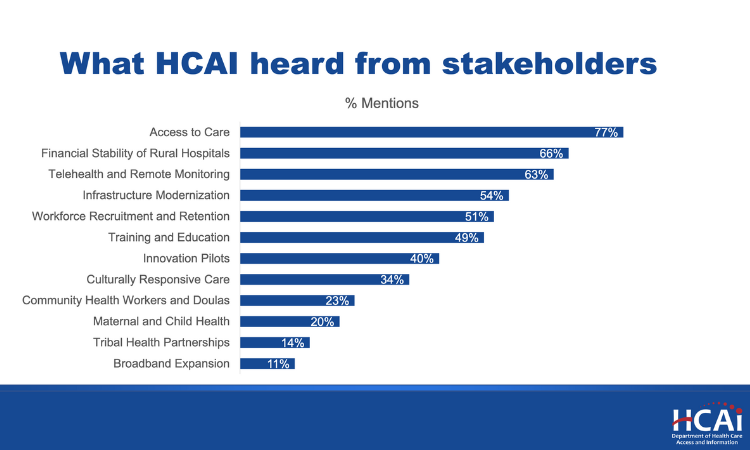
Rural Health Transformation Program readiness and what HCAI heard from you.

Here is your Rural Health Transformation Program Readiness Checklist.

Let’s get ready together.

1. Have we defined our vision across the four RHTP strategic goals? 

CMS and federal guidance frame the RHTP around several key areas, here are the four big themes:

  • Sustainable access 
  • Workforce development 
  • Innovative care 
  • Tech innovation 

Before you draft a single paragraph of a proposal, ask: 

  • If we had meaningful new funding, what would “sustainable access” actually look like in our service area? 
    More appointments per day? A stronger dental program? Fewer no-shows? Extended hours? 
  • What’s our long-term vision for workforce development? 
    Do we want defined career ladders, better onboarding, opportunities for growth, or all of the above? 
  • What innovative care models do we want to build or scale? 
    School-based care, mobile clinics, embedded dental in medical, integrated behavioral health, a telehealth program? 
  • How do we want technology to change daily life for our clinicians and patients, not just our IT budget? 
    Think: easier documentation, better decision support, tighter medical-dental integration, more proactive outreach, second-opinion tools. 

If you can’t articulate even a rough vision in each of these areas, your RHTP plan will end up being a string of buzzwords instead of a transformation roadmap. 

2. Do we have a clear strategy for each of the three “on-the-ground” pillars? 

Underneath those four federal goals, health centers will actually execute in three practical pillars: 

  1. Transformative care models 
  1. Technology and tools 
  1. Workforce development and change management 

Ask yourself the following: 

  • Transformative care models: 
    • Where are the biggest gaps today between what our community needs and what our current model can deliver
    • How will we break down silos between medical and dental health
    • If we want to expand dental access, what does true medical–dental integration look like in our clinics? 
  • Technology and tools: 
    • Which tools actually move the needle on access, quality, and provider experience and which are shiny objects? 
    • Are we prioritizing clinical second-opinion tools, ambient note-taking, telehealth, and data infrastructure that support real care redesign? 
  • Workforce and change management: 
    • Who will champion these changes internally? 
    • How will we support staff through workflow changes, new tech, and new care models – instead of just “dumping another project” on them? 

If your answers are vague, that’s a sign you’re not just “under-documented” – you’re under-decided. 

3. Do we understand what our state is actually prioritizing? 

RHTP is federal, but applications and implementation are state-driven. States submit a Rural Health Transformation Plan to CMS, then design their own program priorities and processes.

Key questions: 

  • Do we know our state’s RHTP timeline, NOFO, and stated priorities? 
    • Which populations, service lines, and geographies is your state emphasizing? 
    • Are there specific expectations around behavioral health, maternal health, telehealth, or integration? 
  • Do we know how funds will flow in our state? 
    • Will health centers apply directly to the state? 
    • Are there regional hub-and-spoke models or consortia being encouraged? 
  • Have we already engaged with our state on the design? 
    • Have we responded to surveys, listening sessions, or RFIs? 
    • Have we clarified how oral health and dental integration fit into the state’s larger strategy? 

If your team is still saying, “We’ll see what the state rolls out and then react,” you’re already behind. Strategically prepared health centers are co-shaping the agenda, not just applying into it. 

4. Are we fixing access with strategy, not just square footage? 

One of RHTP’s core aims is to improve access to care in rural communities, not just keep buildings open.

Before you ask for new space, new chairs, or a new site, ask: 

  • Have we maxed out access with the space we already have? 
  • Are scheduling templates optimized? 
  • At Optimize Practice Alliance, we’ve used scheduling template redesign to help health centers move from the usual 8–13 encounters per provider per day to 50%+ more patient encounters. At Centro Medico, those changes translated into dramatically expanded access with the same number of operatories and staff. 
  • Are hygiene, restorative, and medical schedules aligned to minimize bottlenecks? 
  • Do we consistently run on time, or do we lose capacity to chaos? 
  • Do we have a plan to expand access through better systems, not only more bricks and mortar? 
  • Standardized workflows 
  • Smarter recall and re-care systems 
  • Flexible team-based care models 
  • Can we quantify the access lift of our proposed changes? 
  • e.g., “With these changes, we can safely increase dental encounters by X% using existing operatories and staff.” 

RHTP reviewers will be looking for transformational leverage, not “more of the same, but more expensive.” 

5. What is our recruitment and retention strategy, beyond “we hope people stay?”  

RHTP explicitly calls out workforce development and retention as a priority.  

So: 

  • Do we have clearly defined career pathways and levels for clinical and operational roles? 
  • Can an entry-level team member see a path to becoming a lead, manager, or advanced clinical role? 
  • How strong is our onboarding and training? 
  • Can we reliably take a new grad provider from “brand new” to “highly productive and confident” within a defined timeframe? 
  • We also help health centers build structured clinical development pathways so new-grad providers don’t stay “new” for long. Using a combination of simulation-based training, case review, and progressive skill-building, we’ve supported clinicians in going from fresh graduates to confident, efficient providers who can handle advanced procedures with consistency. This kind of structured development doesn’t just improve clinical performance, it strengthens retention and builds long-term workforce stability. 
  • Do we understand why people leave us? 
  • Are we tracking turnover data and reasons systematically? 
  • Do we know where burnout is highest and why? 
  • If we used RHTP dollars for workforce, would it be one-time bonuses, or structural change? 
  • Training pipelines, professional development, career ladders, and leadership development are far more sustainable uses of funds than short-term pay bumps. 

If your only workforce lever is “pay them more,” you’re leaving a lot of transformation and long-term stability – on the table. 

6. Do we actually have an AI strategy, or just a list of tools we’ve heard about? 

RHTP strongly encourages technology-driven, data-driven solutions that support prevention, chronic disease management, and better outcomes.

For most health centers, that should include an intentional approach to AI. Ask: 

  • Who owns AI strategy in our organization? 
  • Do we have an AI governance group or at least a designated champion? 
  • Do we know what we’re comfortable with and what we’re not? 
  • Are we piloting tools that actually free up clinical time and improve quality? 
  • Ambient note-taking to give clinicians time back 
  • Clinical second-opinion tools (e.g., radiograph analysis, risk scoring, lab decision support) 
  • Predictive outreach to identify high-risk patients earlier 
  • How will we evaluate AI tools? 
  • Impact on access, quality, provider experience, and equity 
  • Data privacy and security 
  • Alignment with our state’s RHTP priorities 

RHTP is a rare chance to build a responsible AI foundation instead of reacting piecemeal to vendor pitches. Optimize Practice Alliance is leading the charge when it comes to AI in dental care. Our AI rollouts routinely give dentists back 26 minutes a day by wiping out the bulk of their documentation burden. And because our CEO, Josh Gwinn, is the founding president of the Denver chapter of AAIA Global, we’re not guessing at where AI is going, we’re helping shape the standards for safe, effective clinical use. 

7. How ready are we for change management, not just project management? 

Most failed “transformations” don’t die because the idea was bad. They die because nobody planned for the human side. 

Ask: 

  • Who is our internal change leader for RHTP? 
  • Is there a cross-functional group (medical, dental, behavioral health, operations, finance, IT) that meets regularly? 
  • How will we communicate changes to staff and patients? 
  • Do we have a plan for training, feedback loops, and iterating without burning people out? 
  • What will success look like in year 1, year 3, and year 5? 
  • Are we setting realistic milestones – not just “Everything will be transformed by 2030”? 

If your RHTP plan doesn’t have a change-management backbone, the best strategy in the world will stall in the day-to-day. 

8. Can we show sustainability once the grant dollars sunset? 

States and CMS will be looking hard at whether proposed projects will survive beyond the funding window.

Your team should be able to answer: 

  • What happens when RHTP funding ends? 
  • Does the project collapse, or does it become self-sustaining through improved revenue, cost savings, or other funding streams? 
  • Do we have a financial model that ties clinical transformation to financial stability? 
  • For example: more completed treatment plans, higher kept-appointment rates, improved coding and documentation, reduced avoidable ED visits. 
  • Are we avoiding uses of funds that can’t be maintained? 
  • e.g., staffing models that only work if grant dollars are permanent. 

If you can’t show a credible path to sustainability, you’re not fully prepared, no matter how strong your narrative is. 

9. Where are we already strong and who are the right partners for the rest? 

Finally, a simple but important set of questions: 

  • What do we already do well that RHTP can help us scale? 
  • Maybe it’s a small but successful mobile-based dental program, or an integrated medical-dental workflow in one clinic. 
  • Where do we openly need outside expertise? 
  • Practice operations and scheduling redesign 
  • Our Practice Optimization Processtm is a strategic, proven framework with a track record of transforming underperforming clinics into high-efficiency, high-access care teams. It’s the same system we’ve used to redesign workflows, tighten scheduling templates, and unlock dramatic gains in patient encounters, without adding staff or operatories. 
  • Dental and medical-dental integration 
  • We help health centers stand up fully integrated medical–dental care models that bring preventive dental evaluations directly into primary care: no extra chairs, no added complexity. This integrated approach consistently uncovers hidden oral-health needs, drives earlier intervention, and opens entirely new access points inside the existing footprint. It’s one of the fastest, most sustainable ways to expand care without expanding your building. 
  • AI governance and clinical second-opinion tools 
  • Workforce pathways and training 
  • Who are we going to call in before we write the proposal? 
  • Implementation partners should be at the design table, not just in the budget appendix. 

Optimize Practice Alliance works with FQHCs and community health centers across the country on exactly these questions, from building sustainable dental programs and integrated care models to designing AI-enabled, clinician-friendly workflows. RHTP is new, but the fundamentals of transformation are not. 

Ready to get serious about RHTP readiness? 

If reading this raised more questions than answers, that’s a good sign. It means you’re thinking at the right level. 

Here’s a simple next step: 

Pull this list of questions into your next leadership meeting.  Have your team rate each area (Sustainable Access, Workforce, Innovative Care, Tech & AI, Change Management, Sustainability) as: 

  • We’re clear and ready 
  • We’ve started, but it’s shaky 
  • We haven’t really tackled this yet 

Rural Health Transformation Program Readiness for 2026

Ready to move from awareness to readiness?
Our RHTP Guide for Health Center Executives was created to help leaders translate RHTP expectations into operational clarity, so your organization is positioned not just to access funding, but to execute meaningful, sustainable transformation.

Because the real question isn’t “Can we get the money?”
It’s “Are our systems, operations, and leadership aligned to deliver on what the RHTP requires?”

Download the RHTP Guide for Health Center Executives to pressure-test your readiness, identify where optimization will matter most, and ensure your health center is prepared for what’s ahead, before the next bend in the road.