Practice Strategy

Navigating your Dental Practice Strategic Plan: 7 Critical Mistakes to Avoid 

Your dental practice needs a strategic plan when you decide to undertake any major changes to your business, your operations or practice focus. That plan is the roadmap of how you will get from here to there, from point A to point B.  

Last week, my partner, Dr. Jack Bayramyan, talked about your vision, the what of your plan. Your vision is your point B, where you want to go, what you want to achieve.  Your strategic plan is the how you achieve that vision. Your strategic plan is the roadmap that gets you to point B.  

The Difference Between a Strategic Plan and your Vision

But your plan needs to be thoroughly vetted and examined so you avoid any soft spots in your planning, execution and communication with your team on what the expectations are going be.

Lack of Clarity in your Vision 

One of the fundamental errors in strategic planning is a lack of clarity. If your goals, objectives, and the steps to achieve them are vague, your team may find it challenging to align their efforts. Be crystal clear about what you want to achieve, how you plan to get there, and the milestones along the way. 

In the ever-evolving business landscape, failing to consider market trends can be detrimental. Stay abreast of industry changes, technological advancements, and shifting consumer preferences. An effective strategic plan adapts to the external environment rather than ignoring it. 

Not Doing a Thorough SWOT Analysis for your Dental Practice 

A SWOT analysis (Strengths, Weaknesses, Opportunities, Threats) is a cornerstone of strategic planning. Neglecting this critical assessment can result in an incomplete understanding of your business’s position in the market. Do a thorough SWOT analysis to make informed decisions. 

This is a great article on using the SWOT analysis for your strategic plan and offers some great templates to follow.

Setting Unrealistic Goals for your Team 

While ambition is commendable, setting unrealistic goals can lead to frustration and a deceleration of motivation. Ensure your objectives are challenging yet attainable. Break down larger goals into smaller, manageable tasks to maintain momentum. 

Neglecting Implementation Plans 

Creating a strategic plan is only the first step. Failing to develop a robust implementation plan is a common misstep. Clearly define team roles and responsibilities as well as timelines to ensure that your strategy moves from paper to action seamlessly. 

Inadequate Communication with your Team  

A strategic plan is a roadmap that everyone in your organization should understand and embrace. Communication is key. Regularly update your team on the progress, changes, and achievements related to the plan. Foster a culture of open communication to keep everyone on the same page. 

Lack of Flexibility  

The dental industry landscape is unpredictable, especially post-pandemic. A rigid strategic plan may become obsolete in the face of unforeseen challenges or opportunities. Build flexibility into your plan, allowing for adjustments and pivots as needed. 

One way to know if you need to pivot or change strategies is by measuring your results as you execute on your strategic plan. This post explains how to measure, what to measure and why to measure. Measuring and testing your strategies is a key component to a healthy and effective strategic plan and should be part of your regular strategy planning meeting cadence.

Crafting a strategic plan is not rocket science but it is a lot of hard work. And taking on this much hard work can only be worth it if you know you’ll succeed. There are no guarantees, of course, but avoiding these mistakes brings you closer to an airtight plan focused on reaching your point B. You got this. Remember, a well-thought-out strategy is not just a document; it’s a living, breathing guide that evolves with your business. 

Turn These Common Pitfalls Into Opportunities for Growth

Running a dental practice means juggling growth goals, patient care, and team management, all while trying to avoid costly missteps. Too often, practices stumble on the same avoidable mistakes that stall progress and drain energy.

At Optimize, we’ve seen firsthand the difference a clear, strategic approach can make. Our consultants work with dentists every day to cut through the noise, uncover blind spots, and set a path for sustainable growth.

Instead of learning these lessons the hard way, you can get clarity now. Book a free 30-minute consulting call with an Optimize consultant, and we’ll walk you through how to sidestep the most common pitfalls holding practices back.
A Vision for your Dental Practice: 12 Key Areas of Value

You didn’t build your dental practice without some sort of plan. And you didn’t create a plan without first having a vision. You know how I know that? Because no one ever wakes up and says, “I want to give myself a whole bunch of work without knowing if that work will ever lead to anything.” Amiright?  

You gotta have a plan if you’re going to be successful but you gotta have a vision of where that plan will lead you. Think of it this way, your plan is how you will get where you want to go, your vision is the place you want to end up at, your point B, if you will. So, in this post, let’s break down what a vision is and how to define it, outline it and make sure it’s on solid ground before you strategize a plan for it.  

Your vision is your point B for your dental practice. It’s where you want to end up at the end of all that hard work. Your vision can be personal or professional or a mix of both so that you’re as satisfied personally as you are with your business results.  

In fact, with the doctors I consult, I make sure they include and prioritize their personal well-being as well as their family’s and team’s well-being. If you don’t prioritize that in your vision, you will watch yourself run ragged for a dream that you’ve come to despise because it’s made too many demands on your mental and physical health. You must be mindful of what you’re capable of and what you need to delegate.   

Along with how you’re feeling personally you want to have a clear picture of what every aspect of your business looks like and where your practice(s) will be when you arrive at your vision. That is typically a 3-year period. So, what is it and how do you use it?  

What is the Vivid Vision® method for your Dental Practice?  

I was introduced to the Vivid Vision method a few years back when I started working with my coach, Cameron Herold. Cameron is the author is Vivid Vision: A Remarkable Tool for Aligning Your Business Around a Shared Vision of the Future and he introduced me to using his Vivid Vision® method in figuring out where I wanted to take my organization. Using that process allowed me to create a vision based on my values, my passions and how I wanted to live my life.  

Cameron Herold on his Vivid Vision® Process

So, what does creating a Vivid Vision® entail? There are 12 key areas of focus that you will need to address in creating your Vivid Vision®. Remember, this vision is your point B, it’s where you want to end up in 1 year, 3 years or 5 years, depending on the current state of your practice.  

I highly recommend doing a full audit of your point A, how your practice is performing right now, so you get a clear idea of how long it might take to get to your point B.

Read this article about assessing your practice, Clarify your Dental Practice Vision: Assess your Point A and Launch your Legacy 

Once you’ve done a thorough assessment of the state of your practice, then you can begin to craft your vision. As I mentioned, there are 12 key areas of focus that you will want to pay attention to as the first steps in crafting your vision. Check out some wonderful examples and a checklist here for some ideas of how to begin and where to put your focus.  

These 12 areas are fundamental to your practice, but they also encompass how you want to live and operate within the boundaries of your organization. This process asks a lot of you in the beginning but watching my organization transform and grow because of this foundation I created has been the most rewarding experience of my professional life. I urge you to take the time to do your due diligence and answer all these questions fully.   

The first thing that goes on the blank page is the statement –  

“It’s December 31, 20__ …”  

This beginning will help put you in the future and let you see what your practice can look like in that year, typically that year will be 1 year, 3 years or 5 years from the day you begin writing your vision. Be generous with yourself, don’t try to solve every issue, transform your culture and double your annual revenue in one year. Give yourself time to fulfill this vision.  

Your Personal ‘Why’  

Why I do what I do – These 1 to 3 sentences are a description of why you started your practice and what you hope to achieve with it. This comes from the heart. Keep it simple and short.  

Core Values – Paired with your personal ‘why’, your core values are what will guide your vision. You don’t want to put yourself in the position of going against your values even and especially in business. Identifying your core values will help you make decisions about your practice while crafting your vivid vision. Do you know your core values?  Check out James Clear’s list of core values here.  

The People in your Dental Practice 

Culture – What do you want your team culture to look like? How do you want to interact with people in your offices? How do you want them to interact with the public and your vendors? What kind of cohesion do you want to build within your teams? How do you want to build that cohesion?   

Team/Employees – Write down every key role in your practice. Do you have the right people in the right seats? Is everyone doing the job they are best at and most passionate about? Do team members work and live with purpose? 

What You Do – Your Dental Practice Focus 

Core Business Activity – What does your dental practice specialize in? Emergency care? Cosmetic dentistry? Are you a concierge practice? Detailing your USP or unique selling proposition will help you create offers, messaging and services in alignment with your core business activities.  

How the World Sees Your Dental Practice 

Operations – How do your patients see your practice? What do your reviews and testimonials say about your services, operations and in-office experience?  

Offices/Headquarters – What does your office feel like walking into your practice? Does the office reflect the types of services you offer? A comforting environment for emergency dentistry? Or a sleek, upscale vibe reflective of a cosmetic dentistry practice? A homey feeling for a more traditional hygiene practice? Does your office aesthetic reflect your practice’s services and values?  

How Your Dental Practice Communicates with the World 

Sales/Marketing – How do you communicate with the world to attract patients to your practice? Do you have a marketing strategy? Is it based on your core values and mission? Is your social media presence reflective of your core values? Is your marketing strategy successful?  

Community Involvement & Giving Forward – Does your dental practice support local and community-based charities or organizations? Do you have sponsorships, scholarships or dental intern programs? How do you give back to your community?  

How Media Portrays your Dental Practice 

Media & Awards – What has the media said about your dental practice organization? How are you portrayed to the public? Have you been recognized in local or national publications?  

The KPIs of your Dental Practice  

Financials – This aspect of your vision is your chance to see the actual heartbeat of the dental practice. What are your sales, yearly revenue and profit? What is your annual growth rate? Have you done an EBITDA analysis of your practice?  

From Dental Practice Owner to Investor and Leader 

Founder Feeling – Although this is the last key area of your vision, I consider it one of the most important ones because this is where you take time to evaluate how you want to show up in the practice, your day-to-day interaction with your practice and your mindset.  

Ask yourself, “how do I want to spend my time?” “What does my daily activity look like?” “How do I want to feel every day?”  

You can also take time to write down your mentors, how you became a dentist, what your core motivation was, your initial passion for starting your business and what personal growth looks like now to you. Take your time. Write down from the heart, where it all began, how it’s going and where you truly want to be by December 31st, 20___.  

This is an incredibly transformative experience if you dare to embark on the journey of crafting your Vivid Vision®. This brief overview that I’ve laid out here is only the beginning. If you would like more information, I recommend checking out Jennifer Hudye and her site Conscious Copy & Co. And here’s more info on my Vivid Vision® process, check out my book, Extraction: The Surprising New Formula to Systemize, Scale and Sell Your Business.

Remember, to get to point B, you need to start at point A, define where you want to end up, your point B, and then develop a strategy for how you’re going to get there. But the first step is always to define what point B looks like for you. Similar to a GPS system, you punch in where you want to go, then punch in where you are, once you have both of those coordinates you can devise or choose a strategy for getting there from here.  

One More Tool for your Toolkit 

At first glance, creating a comprehensive vision for your dental practice might seem overwhelming—another big task on top of everything else you do to keep your business running. But there’s a powerful reason to take this step: to design the life and practice you truly wanted when you started this journey.

As a practice owner, you quickly discover you’re not just a dentist, you’re also the CEO, the strategist, and the visionary. If you’re feeling the weight of burnout or wondering how to recapture that original spark, you’re not alone. Many dentists face these same challenges as their practice grows.

That’s why we developed the Extraction GPS Template. This free, step-by-step worksheet helps you clarify your vision, define your values, assess where you are now, and set clear goals for your practice’s next chapter. With the Extraction GPS, you can turn those 12 key areas of value into a concrete, actionable plan, so you can build the business and the life you’ve always envisioned.

Ready to take control of your future and lead with clarity?
Download your free Extraction GPS Template now and start mapping out a vision that works for you, your team, and your family.

Strategic Planning for your Dental Practice: A 10- Point Roadmap to Achieve Success  

Do you have any big plans for your dental practice this year? If so, do you have a strategic plan for those plans? Last week, we talked about the difference between a vision and a strategic plan. In this post, let’s look at how to create a strategic plan for your big goals.  

When you create a Strategic Plan, what you are really creating is a roadmap that bridges the gap between where you are right now and what you want to achieve. Your Strategic Plan is what my partner, Dr. Jack Bayramyan, likes to call your Growth Positioning System.  

The planning process is a way of reverse engineering your vision into measurable goals and then developing a written plan with a clear understanding of the obstacles in your path, investments you need to make and the resources and capabilities you need to have to achieve these goals.  

For Your Dental Practice to Grow, first you Need a BHAG 

The steps laid out below are the exact steps that Dr. Jack used to develop and reach his BHAG or Big, Hairy Audacious Goal. The BHAG concept was developed by Jim Collins in his book Built to Last: Successful Habits of Visionary Companies.  

One of the advantages of having a huge goal is that it gets you out of bed in the morning. We can utilize the Goldilocks effect here: your goal can’t be so small that it’s easily achievable and offers no excitement or challenge to you or your team; but it also can’t be so big that it’s seemingly impossible to achieve or too intimidating for your team to even think about. Your BHAG must be right.  

And you’ll know that your goal is just right when you can easily reverse engineer it and can build the roadmap to achieving it.  

BHAG for your Dental Practice

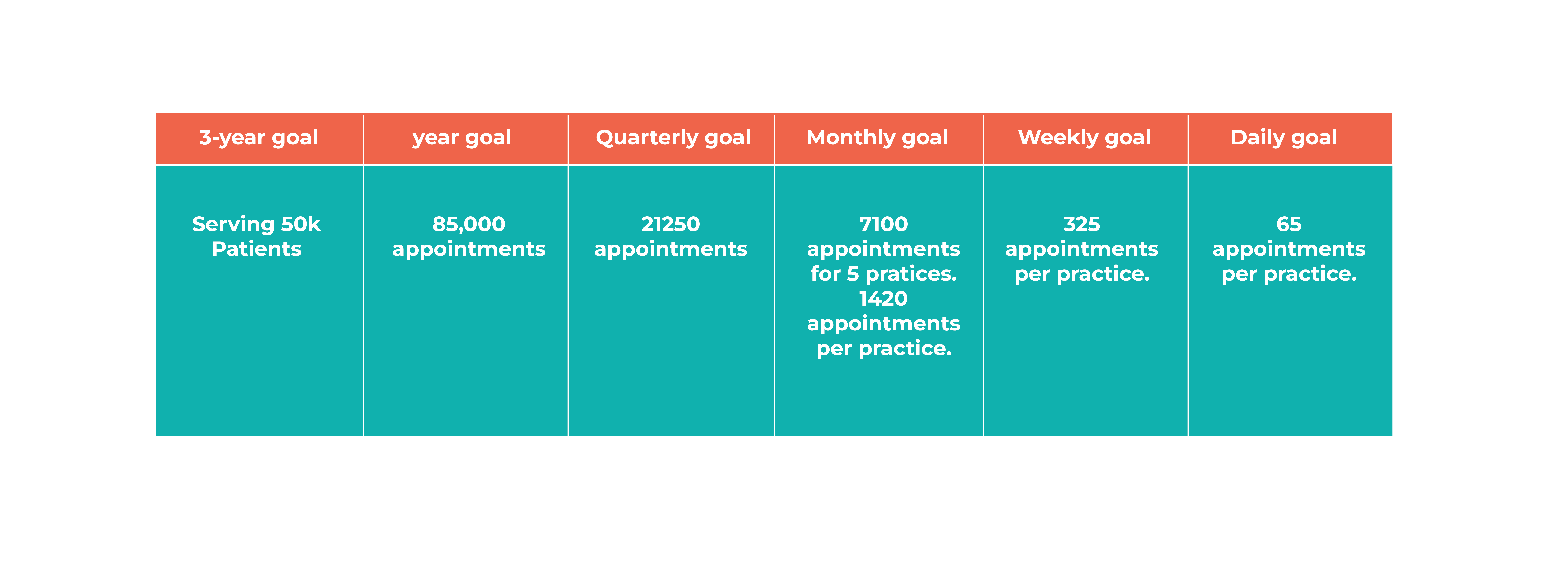
This image illustrates how you can break a goal down into achievable parts over time. This particular goal is for a multi-site practice. The BHAG is growing the practice to “Serving 50k patients in 3 years.” We break this goal down into yearly, quarterly, monthly, weekly and daily goals.

In order to achieve the daily goal of 65 appointments per practice, you can reverse engineer that to see how you’ll achieve it. Do you need more operatories? Do you need to hire more hygienists or associate dentists? Do you need to overhaul your patient management software?

And remember, you don’t want to create a goal that is so big it feels unachievable or so small that you and your team aren’t inspired or challenged. It should feel a little scary but not terrifying. The same goes for your resources. Don’t over-commit your resources or take on something that will cost you or your organization more than you can afford in time or money. That’s why a plan is necessary, it will help you see what is achievable and what might need to wait.

Your Dental Practice Strategic Plan 

Ok, so you’ve got your BHAG. Now what? Let’s look at the exact plan Dr. Jack followed to reach his goal. This is a breakdown of steps you need to take and questions you need to answer for your strategic plan.  

Clarify what you want to achieve in your Dental Practice 

  • You need to be very clear about where you want your practice to end up when you achieve your goal. For instance, you may want to increase the number of patients seen by a certain amount. You will need to know how many patients your team, practice and operations can handle and what the limit is so you can plan to face the challenges that will arise as more patients come into the practice.  

Write down your measurable goals into a well- developed measurable scorecard to be shared with your team  

  • Very similar to the goal chart [see image above] that Jack created for his team, you can break down that goal into increments to see how to reach it, how to delegate the different tasks to your team, and how to create the correct strategies for measuring those goals.  

Set deadlines by breaking down your three-year goals into annual, quarterly, monthly, weekly and daily objectives  

  • One of the most helpful tools I’ve found as a CEO is insisting on my teams keeping a regular meeting cadence. Meetings dedicated to one topic, in this case your BHAG will keep everyone focused on the objectives and cohesive in your strategy.   

Identify and list all the obstacles in your path preventing you from reaching your goals and objectives 

  • Taking the example above, of “increasing patients seen,” you can begin to see where your practice is optimized to receive new patients and where you may face challenges when that number increases. For instance, you may not have a big enough team. You may need to hire an associate or another hygienist. These are the specifics that you will become aware of when you create your plan and look for the obstacles to reaching BHAG.  

List all the resources and capabilities you need to transform those obstacles into growth 

  • These resources may be a more robust CRM (customer relationship management system); You might consider hiring a marketing agency to help you attract, retain and track new patients; with these changes, you may find that your accounting software needs updating. Fleshing out the details of what you already have on hand and where you may need to expand, fund or source new resources or capabilities will save you money and time in the long run.  

Organize your goals into a sequence of priorities  

  • Follow the 80/20 rule which states that 80 percent of your results will come from 20 percent of your activities. It’s important to list them in order of priority and sequence with detailed steps, dates and timelines.

Build an accountability structure for your team 

  • Create a visual accountability chart with specific goals and deadlines for each critical role in your business: most importantly, marketing/sales, operations, and finance. That way, each person knows exactly what part of the BHAG they are responsible for while also knowing the timeline for execution and completion.  

Assign a member of your leadership team to each role. Note that some leaders may have multiple roles 

  • Make sure that each team member knows not just what and when to execute and complete their responsibilities but how they’ll get your vision completed. They will need the proper resources and hands to get the job done. Another quick tip is reviewing that accountability structure in your monthly or quarterly meetings.  

Calculate the investments you need to make to acquire the resources and capabilities listed above  

  • Reaching your BHAG will most likely take a lot of resources including money. You may need to take a business loan, source investors or find revenue in your business. No matter how you source and acquire that money make sure it’s accounted for and earmarked for your BHAG and not simply quotidian funds in your practice. You must keep your eye on the ball.  

The investment you make is a critical part of strategic planning. This investment is not only money, but your time and energy towards the commitment of achieving your BHAG and ultimately realizing your vision for your dental practice.  

Undermining the value of investments and confusing investments with expenses has been the greatest bottleneck to growth for many entrepreneurs and organizations. It’s a good rule of thumb to remember we must invest before we can unlock the benefits of growth.  

Your Dental Practice Strategic Plan Needs A Framework 

Now that you’ve designed your strategic plan, the real work begins… execution. Setting a bold goal, enrolling your team, allocating resources, and committing to the journey ahead can feel intimidating. Big visions tend to do that. But when you know exactly how you’re getting from Point A to Point B, much of that fear fades into focus.

A clear roadmap is essential, but it only works if it’s supported by the right mindset. Belief, discipline, and follow-through are what turn plans into progress. Without them, even the best strategy stays stuck on paper.

That’s why we created the Extraction GPS. This tool helps dental entrepreneurs clarify their values, assess their current reality, and define a clear, intentional path forward. It turns strategic planning into something usable, something you can return to when decisions get hard, momentum slows, or distractions creep in.

Vision plus effort is powerful. Vision plus effort and clarity is unstoppable.

Ready to turn your strategic plan into intentional action?

Leverage a Successful Exit in your Dental Practice: The #1 Tool for Scaling and Exiting

This month we’ve taken a deep dive into scaling your dental practice and doing it successfully. Scaling any business is time-consuming and work intensive. You need the right teams, tools and resources to scale effectively. And there is one tool that stands out among all the others. But this tool is versatile. There are a couple vital ways to use it, so let’s get into it.

In the dynamic landscape of dental practice management, finding effective metrics to guide growth is crucial. One such metric that has gained prominence is EBITDA, or Earnings Before Interest, Taxes, Depreciation, and Amortization. This is also a tool used by PE, banks, and other investing institutions when they are interested in buying a dental practice or organization. So, why not learn how to use this tool to your advantage, even and especially when devising your exit strategy. In this post, we’ll explore how leveraging EBITDA can be a strategic move to scale and even selling your dental practice. 

Understanding EBITDA and How To Use it for your Dental Practice 

EBITDA is a financial indicator that provides a snapshot of a company’s operational performance by excluding certain non-operating expenses. It essentially measures a company’s ability to generate operating income before considering the impact of financing and accounting decisions. Investors use this tool so they can have a clear picture of your short-term operational efficiency, in short, a dental practice’s profitability.

EBITDA essentially isolates earnings in your dental practice to gauge the value and feasibility of your practice as it stands separate from external financial factors.  

  • Earnings: The total revenue (all the money earned from your dental services) minus the cost of services sold (the money spent to offer those services). Also known as net income. 
  • Interest: The cost of debt financing (like loans or credit). 
  • Taxes: The amounts paid to the government can vary and thus are excluded. 
  • Depreciation: The decrease in value of tangible assets (like operatory tools and equipment, office equipment, etc.) over time. 
  • Amortization: Similar to depreciation, but for intangible assets (investor arrangements, real estate, dental offices, etc). 

Why EBITDA Matters for Scaling your Dental Practice 

1. Operational Efficiency:

EBITDA focuses solely on the core operations of your dental practice, making it an effective tool to assess operational efficiency. By identifying areas where costs can be optimized, dental practice entrepreneurs can streamline their operations for better scalability. This is also an incredibly valuable tool for dental practice exit strategies. Having a clear picture of your operational efficiency can put you in a strong negotiating position while giving you better tools for exit strategy planning.

2. Comparative Analysis:

EBITDA allows for easy comparison between organizations in the same industry. This can be invaluable for benchmarking your dental practice against your competitors, identifying areas for improvement, and implementing best practices to foster growth as well as exit strategy analysis.

3. Investor Appeal:

Investors often look at EBITDA as a key metric when evaluating an organization’s financial health. A strong EBITDA margin can make your dental practice more attractive to potential investors, facilitating funding opportunities for expansion and exit. You’re in a much stronger negotiating position when you see what they see and work on increasing your profitability.

You May Also Like This Post:

Steps to Utilize EBITDA for Scaling your Dental Practice 

1. Detailed Financial Analysis of your Practice:

Conduct a thorough analysis of your dental practice’s financial statements to calculate EBITDA. Understand the components and identify any extraordinary items that might distort the true operational performance of your practice. This step cannot be overlooked. In order to get from point A to point B, you’ve got to design a roadmap with the correct data and information.

2. Identify Cost Optimization Opportunities:

Utilize EBITDA as a tool to pinpoint areas where costs can be optimized without compromising operational efficiency. This may involve renegotiating contracts with your vendors, streamlining processes, or investing in upgraded technology for your operatories for greater efficiency. Whether you’re scaling or planning to exit, optimizing your operations will have strong long-term benefits.

3. Strategic Decision-Making:

Armed with a clear understanding of your dental practice’s EBITDA, make strategic decisions aligned with your growth objectives based on your Strategic Plan. This might involve where you choose to open your next location, expanding services perhaps into cosmetic or surgical dentistry, investing in affiliates and partners to increase value, or building your strategic plan for exiting your dental practice organization.

4. Communicate Effectively:

When communicating with stakeholders, including team members, investors, and partners, use EBITDA as a transparent metric to showcase your practice’s financial performance. This fosters trust and confidence in your growth strategy and strategic planning.  

One More Tool for Investing in your Dental Practice  

Leveraging EBITDA can be a game-changer for dental practices aiming to scale or exit successfully. By focusing on operational efficiency, comparative analysis, and strategic decision-making, a dental entrepreneur can use EBITDA as a compass to navigate the path to sustainable growth or a profitable exit.

And don’t overlook mindset. The mindset of a dental entrepreneur cannot be underestimated. You are the driving force behind your vision, mission, and strategic plan. Your passion and clarity are what inspire your team, your vendors, and your partners, they need to trust not just where your practice is headed, but that you have a plan to get there.

If you’re ready to put your vision into action and keep your finger on the pulse of your practice’s value and growth, the next step is simple: track your key performance indicators.
That’s why we created the OPA KPI Tracker, a free, easy-to-use tool designed for dental entrepreneurs. With it, you’ll gain clear insights into the metrics that matter most for scaling, boosting EBITDA, and preparing for a successful exit… whenever that day comes.

Ready to turn clarity into momentum?
Download your free OPA KPI Tracker now and start making every decision data-driven, from growth to exit and every step in between.

The future of dentistry belongs with dentists.

Scaling Your Dental Practice: 7 Comprehensive Steps to Prepare your Practice for Success

Scaling your dental practice is not just about creating new and more locations; it’s also about enhancing your operations, patient experience, online presence and community impact. In this comprehensive guide, let’s delve into various strategies to help you scale your dental practice organization effectively. 

The Need for Scaling your Dental Practice  

But first, let’s talk about why scaling is crucial for any business looking to survive. The Covid-19 Pandemic and its ensuing upheaval brought with it massive disruption, confusion and chaos into every aspect of economic life and especially small businesses and the medical industry writ large. At the intersection of small business and the medical industry is where dentists and dental practices live and die.  

This disruption and upheaval brought devastation to many and opportunity to a few. The last few years have been banner years for private equity as opportunists for the weak and slow-moving. But another group has emerged and begun to flourish as well during the chaos and confusion…the dental entrepreneur.  

Your Dental Practice through the Eyes of an Entrepreneur  

The businesses and entrepreneurs who stayed afloat during and after the pandemic are the ones who learned to pivot, stay nimble, be curious and cultivate risk to discover opportunity. And dental practice owners were no exception to this new behavior. No longer was the status quo acceptable.  

Dentists and dental practice owners needed to learn many new skills, study new landscapes and be willing to take their teams into uncharted territory to stay in business, much less thrive. And the ones who succeeded were often the ones who figured out that scaling their practice model was going to save them from the jaws of the PE sharks in the water or even the last gasps that comes with a dying practice.  

These hard-working dentists and dental practice owners are true heroes in my book, having survived some of the most difficult economic times in recent memory only to enter the even more uncertain times that we are all now experiencing. To face certain extinction with grace, curiosity and energy and decide that you will succeed in such turbulent waters is a testament to the character, selflessness and perseverance of dentists that I have seen from the very beginning of my career starting with my first volunteer mission trip to Mexico as a young dentist. 

Scaling your business model is essential if you don’t want to become chum for the sharks or fade into obscurity with no legacy. It is an absolute must for a practice owner to remain successful in these times.

So, what are the elements of scaling your dental practice successfully?  Let’s review these elements so you can create your own comprehensive blueprint for success. You want to get to point B. First, let’s put in some coordinates, some steps to help you get there.  

Embrace Technology in your Dental Practice  

As the dental industry continues to evolve, new technologies are constantly being developed to improve patient care, enhance diagnosis and treatment, and streamline dental practice management. 

Integrating these new technologies and modalities can significantly enhance the efficiency of your dental practice. Improve and refine your diagnostic tools and skills; stay in better touch with patients; see and study long-term trends in your patient activity; create tailor-made recall and reactivation campaigns and outreach; and reduce the time your team spends on repetitive record-keeping.  

There is no better time to research new and emerging technologies than when you are about to embark on a scaling program in your dental organization. Take some time to get out there, visit conventions, conferences and webinars and get an expert understanding of game-changing technologies.  

Optimize your Online Presence and Marketing Strategies  

Your practice’s online presence is often the first point of contact for potential patients. Ensure your website is user-friendly, informative, and optimized for search engines. Dive into the world of dental SEO to improve your visibility online. As stated in the previous paragraphs, new technologies are emerging to assist your practice in SEO, patient management and outreach and building websites that provide the best online experience you can give your prospective and existing patients.  

Don’t forget the power of social media – engage with your audience, share valuable content, and humanize your practice. Introduce your team to the world. Craft targeted marketing campaigns and ads to reach your desired audience. Utilize a mix of online and offline channels as well as paid and organic content to maximize your reach. Measure the ROI and effectiveness of your marketing efforts weekly to refine your strategies over time. 

Enhance the Patient Experience in your Dental Practice  

Creating a positive and welcoming environment is key to retaining patients and attracting new ones. And that starts well before a prospective patient enters your practice. As stated previously, having a robust online presence gives patients a lot of information to digest. It also gives them an initial impression of your practice, your team, your associates and you.  

After creating a comprehensive online patient experience, it’s essential to implement mechanisms for gathering patient feedback to continuously improve your services. Along with feedback portals, research and create a robust plan for patient recall and recare. Exceptional customer service goes a long way in building lasting relationships with your patients. 

And patient satisfaction can become an incredibly rewarding experience that includes long-term loyalty and feeds a strong referral system.  

Collaborate with Specialists 

In addition to a healthy loyalty and referral system for your patients, consider building partnerships and referral programs with other healthcare professionals to offer outside care and services to your patients. Establishing referral networks not only improves patient outcomes but also expands your practice’s reach within the medical community. This kind of outreach and referral builds your reputation and establishes strong ties to your community and the medical community in your locations’ areas generally.

Establishing relationships with orthodontists, dental surgeons and cosmetic specialists can become a strong feedback loop for your practice as you build your organization and your reputation.  

Staff Hiring, Training and Development 

When I built my first practice, I became curious about hiring and retention. Early on, I had a terrible experience watching my first office manager quit and take all her knowledge of our bookkeeping, patient recall and insurance reimbursements with her. I was stranded. The reason she gave for leaving was she felt the culture I was building within our practice was simply not for her. So, she left.  

That was an extremely painful and costly lesson for me. I ended up losing quite a bit of money from lapsed reimbursement invoices, etc. But it also left me questioning how to build an organization that people loved and didn’t want to leave. I spent a long time investigating and researching psychology and culture, a process I detail in my book, Extraction. Check it out for a comprehensive understanding of team building and cohesion.  

From that experience, I created and invested in programs and processes that allowed me to have clear lines of communication with my team; set guidelines for expectations; and set team members up for success. We started a book group, created and tracked personal and professional goal development and invested in ongoing education and development. I also made it a priority to set a tone of inclusion, diversity and camaraderie amongst team members, so everyone felt like a part of the team.   

This kind of effort, though extraordinary for some practices to undertake, became a cornerstone of our culture across 8 dental practices. Our retention rate was extremely high, in fact, it was something that I didn’t have to give much thought to because my focus was on making sure my team was happy, fulfilled and capable. Jim Collins is a wonderful resource for learning to understand what you need in team members and making sure they are the right fit for your organization. Read more about my experience here and read about Jim Collins’ work with teams here.   

Community Involvement and Investment

Making sure you have happy patients and happy team members is an imperative to scaling a successful operation. But one other area to think about is the community you’re setting up your first, second or third dental practice in.  

Engaging with your local community to build a positive reputation through hosting events, sponsoring local activities, and partnering with other businesses can elevate your practice’s standing within the community. In this digital age, it is so easy to forget and neglect your community IRL. Amiright? 😉  

Create Community around your dental practice
Engage and support your local community to elevate your dental practice.

Incorporating community-outreach programs into your strategic scaling plan may seem like overkill or extra work, but it is truly that extra mile you go that people notice. It may take a little bit of time to make the connection but when people see your organization’s name around the community and see how you’re investing in the environment that allowed you to set up shop, their recognition and commitment to you will become one of the linchpins of your success and longevity. People can’t help but want to give back to the ones that gave to them.  

The Path to Long-Term Growth for Your Dental Practice

Scaling your dental practice requires a holistic approach that combines technology adoption, patient-centric strategies, and strong partnerships. By following these comprehensive steps, you’ll not only expand your business, but also strengthen its roots in the community for sustainable, long-term growth.

But even the best strategies need a way to measure progress. Without clear data and tracking, it’s easy to lose sight of what’s really moving your practice forward, or what needs adjustment.

“A goal without a plan is just a wish.” ~ Antoine de Saint-Exupéry

That’s why one of the smartest steps you can take right now is to implement a simple, effective KPI tracking system. When you consistently monitor your key performance indicators, you create a strategic roadmap for scaling: you’ll spot opportunities sooner, address challenges faster, and lead your team with clarity.

To make this easier, we created the OPA KPI Tracker, a free, dentist-friendly template designed to help you track what matters most. Whether you’re planning your next big move or simply want to keep your finger on the pulse of your practice, this tracker is your companion for smarter, more confident growth.

Ready to move from goal-setting to real, measurable progress?
Download your free OPA KPI Tracker now and take control of your practice’s growth journey, one metric at a time.

Scaling Your Dental Practice: 6 Actionable Benefits to Unlocking Your Growth, Prosperity and Legacy

Scaling a dental practice might seem daunting in today’s economic mine field of private equity takeovers, the possibility of recession constantly on the distant horizon, a labor-driven economy and slim profit margins. But it may be the smartest move you consider planning for right now.  

Scaling a business is akin to nurturing a thriving garden. Your dental practice must be in good shape before you develop a strategic plan to scale. After all, scaling, in essence, is duplicating the success you’ve already created. You don’t want to duplicate your past stagnation. You want to figure out why and how you created your success and then duplicate that.  

It requires careful planning, consistent effort, and the right conditions to flourish. For dental practice entrepreneurs, the decision to scale is a pivotal moment that opens doors to a myriad of benefits. Let’s delve into the advantages of scaling your dental practice and why it’s a strategic move for your long-term success and your legacy.  

Increased Revenue and Profitability for your Dental Practice 

The whole point of scaling your dental business is to introduce new revenue streams. As you expand your services, reach new demographics, and explore additional revenue channels, the financial health of your organization receives a significant boost. 

As your business grows, you now have the ability tap into new markets, attract more customers, and offer additional services. This diversification of revenue streams will help stabilize your profit margins and create a foundation for sustained profitability. In essence, it’s the age-old idea of spending money to make money. Using this strategy smartly allows you to grow your dental organization comfortably.  

In designing your strategic plan for growth, you will consider incorporating new dental services, exploring different locations that align with your market and patient profile, and researching innovative treatment solutions. This not only caters to a broader patient- base but also opens up opportunities for higher-priced services, contributing to a healthier bottom line while attracting and keeping a diverse patient population.  

Enhanced Brand Visibility 

A scaled dental practice commands attention in the marketplace, elevating your organization’s visibility. This heightened recognition not only attracts new patients but also establishes your dental organization as a prominent player in the industry as well as the communities your organization serves. A strong brand presence fosters trust and confidence among both existing and potential patients. 

And this includes online visibility. For a scaled dental practice organization, a strong online presence is crucial. Scaling provides an opportunity to invest in digital marketing strategies that can significantly boost your visibility and engagement. Consider expanding your social media presence, investing in targeted advertising, and optimizing your website for search engines. 

 Include in your strategic plan, strategies for patient-nurturing programs, social and traditional media marketing efforts as well as community outreach programs to affiliate with your organization. 

Operational Efficiency and Cost Optimization 

Scaling your dental practice will require streamlining and optimizing your business processes. A proper strategic plan for growth will lead to improved operational efficiency across your organization, reducing costs and minimizing waste. You can leverage tools and technologies to automate repetitive tasks, allowing your teams to focus on more strategic and creative aspects of your online presence.  

Explore project management tools, diagnostic tools, and analytics software to enhance your teams’ abilities to meet demand not just efficiently but also effectively. And with the advent of new AI technologies constantly coming online, this could prove to make these analyses and tasks easier to navigate. This exploration and implemenation will ensure your teams, as well as patients, are happy with the results. Efficiency gains not only save time but also make your operations more agile and responsive to patient needs and market trends. 

Creating a strategic plan for scaling necessitates a thorough examination of your operational processes. This evaluation alone can often lead to increased efficiency, better resource utilization, and cost optimization. Whether it’s implementing advanced technologies like AI or streamlining administrative tasks, the result is a leaner, more agile organization. And a lean, agile dental practice is ready to scale.  

The dental industry is dynamic, with trends and patient preferences evolving rapidly. Scaling your business ensures that you remain adaptable to these changes. Whether it’s adopting cutting-edge dental technology or introducing innovative service offerings, scalability enables your organization to stay ahead of the curve. 

Talent Acquisition and Development 

As you scale your business, you will need to expand your team. Undeniably, this will mean figuring out how to attract skilled and motivated professionals. There are two aspects to this process: attracting the team members you want and figuring out how to retain them. You will need to integrate professional development, training programs, and career advancement within your organization to attract the people you want.  

Keeping them means fostering a culture of continuous learning and development through Investing in training programs, mentorship initiatives, and employee benefits.  

While you’re implementing these initiatives give thought to yourself and your leadership skills. Because retaining the kind of professionals you want means developing a top-down structure of accountability, inclusion and diversity. Taking the time to understand and integrate the values that you want reflected in your workplace will mean greater team buy-in when you introduce your team to your strategic plan for growth.  

If your team sees themselves reflected in your strategic plan for scaling they’re more likely to take on these efforts and own them, thereby helping you share the scaling challenges and labor efforts. My business partner, the President and Founder of OPS, Dr. Jack Bayramyan, has written an excellent book on his personal experiences scaling his single practice to a thriving dental practice organization spanning two states.

The last chapter in his book is dedicated to the dental practice owner turned investor and entrepreneur. In it, he delves into the tools, strategies and experiences that shaped his leadership style and helped him achieve his astounding success. Learning to shape is leadership gave him the skills to assemble the team that ultimately drove his success. Give it a read.  

Extraction by Dr. Jack Bayramyan - Dental Practice

Improved Patient Experience 

Scaling your dental practice allows you to enhance the overall patient experience. Learning to Implement customer feedback systems to gather insights and make data-driven improvements to your services will greatly enhance your understanding of what patients need and want.

At the same time, the type of outreach shows patients and potential patients that you are interested in what they have to say and what they are looking for. In referral-based marketing this kind of outreach goes along way with the communities your organization serves.  

In your strategic planning, research and invest in technologies that facilitate smoother appointment scheduling, communication, and follow-ups. Personalize your interactions with patients through tailored communication strategies as well as new dental technologies to enhance patient-experience and entice new patients. Building a positive and memorable experience for your patients not only encourages loyalty but also generates positive word-of-mouth referrals, a powerful tool in dental care. 

Risk Mitigation for your Dental Practice Organization 

Diversifying your dental practice through scaling can act as a risk mitigation strategy. Relying on a single service or a limited market exposes your practice to potential downturns. Scaling allows you to spread your risks across various services, locations, and patient segments. 

Diversifying allows you to stay ahead of the competition, which can feel like a perpetual challenge. Scaling provides a competitive advantage by positioning your dental partnership organization as an industry leader.  

In developing your strategic plan, think of scaling as a necessity for risk-mitigation as well as organizational health and longevity. Your plan for the long-term survival and health of your dental practice must include scaling. The challenges you’ll face while scaling are much more exciting than the ones you inevitably face if you do nothing in an era of exponential growth and development.  

A Strategic Plan for Scaling your Dental Practice  

The dental industry is no exception to wildly fluctuating market forces at any given time. If you do nothing, you risk losing everything you’ve worked for to this point including your legacy. In this moment of incredible technological upheaval there are those ready to take advantage of this upheaval and those that will fall by the wayside; very similar to what we saw during the pandemic. Scaling your practice, as I stated, is a direct and effective way to avoid becoming irrelevant while ensuring your future success.  

If you do plan to scale your practice, you need to start with creating a strategic plan.  

Scaling your dental practice is a strategic move that unlocks a myriad of benefits. From financial prosperity and enhanced brand visibility to operational efficiency and adaptability to industry trends, the advantages of scaling are vast and transformative. As you embark on this journey, remember that scaling is not just about getting bigger; it’s about building a foundation for sustainable success and ensuring your legacy.  

Track What Matters Most to Scale Your Dental Practice

There are countless challenges you’ll face as you scale and implement your growth strategies—but you don’t have to navigate them blindly. One of the most effective ways to overcome obstacles and accelerate your progress is by consistently tracking your practice’s key performance indicators (KPIs).

The right KPIs help you see what’s working, spot opportunities, and address issues before they become costly. That’s why we created the OPA KPI Tracker—a simple, powerful tool designed for dental entrepreneurs who want to make data-driven decisions and unlock new growth.

Ready to gain clarity on your numbers and take control of your growth?
Download the OPA KPI Tracker below and equip yourself with the insights you need to scale your dental practice with confidence.