Practice Strategy

How Does Culture Contribute to the Bottom Line in Your Dental Practice? 

Communication, Clarity and Cohesion within Your Dental Practice is paramount to your success. But how do you achieve it successfully? I’ve just finished reading The Four Obsessions of An Extraordinary Executive: A Leadership Fable by Patrick Lencioni. It’s a very good illustration of how mindful leadership leads to success throughout an organization. It’s told in the manner of a Rich Dad, Poor Dad type of scenario. One company thrives while the competing company struggles under a frayed culture. While I didn’t find any information that was new to me, it illustrated extremely well how an organization bereft of cohesion, focus, communication and intention suffers and implodes. While an organization driven by a leader with clear vision, strong intentions, transparent and direct communication thrives in an environment of cohesion and unity.  

The book echoes my own beliefs and leadership style and I was reminded of a lot of sound principles and strategies. So, it’s a good reminder for a seasoned team leader and an excellent resource for someone new to a leadership role.  

Four Principles to Establish in Your Dental Practice 

The primary focus of the book to teach leaders how to ensure that their entire team structure is 100% clear on the focus and intention of the organization. I don’t disagree with anything that Lencioni illustrates in the book as important to a leadership role. These are solid principles that will enhance any leader’s role while training new leaders in sound strategies to take into any future leadership position.  Lencioni calls them disciplines:  

  • Discipline 1 – Build a Cohesive Leadership Team

Lencioni considers this the most important of the disciplines in creating a healthy organization with leadership that develops and maintains high-performance.  

  • Discipline 2 – Create Clarity 

The book examines six questions that root out contradiction and cross-purposes in order to create cohesive clarity at the executive level, an essential step before attempting clarity within the organization.  

  • Discipline 3 – Overcommunicate Clarity 

Once clarity is established at the ‘top’ that messaging needs to be communicated over and over again to the entire company, while maintaining consistency, intention and focus.  

  • Discipline 4 – Reinforce Clarity 

The answers to those six questions need to be reiterated again and again to ensure it becomes “embedded into the fabric of the organization” while all functions of the organization are filtered through those answers.  

The book makes it clear that it is the leaders’ job to build and fully protect the culture of the organization. And it is up to the leadership team to ensure that throughout the organization everyone understands what the company aspires to be, and the principles with which it operates.  The focus, as Lencioni makes clear, is on ensuring that all communication flows down to team members in a manner that continually and consistently establishes alignment throughout the organization. 

This book is worthy of your time if you aspire to a leadership role, want to enhance your leadership capabilities or are entering an organization badly in need of a cultural makeover.  

How Does the Culture You Create Affect Your Bottom Line in Your Dental Practice?  

Culture is built through intentional leadership. As a practice owner, it’s your responsibility to define what’s acceptable, what’s encouraged, and what’s non-negotiable. Without clear direction and consistent follow-through, cultures drift, leading to misalignment, inefficiency, miscommunication, and wasted energy.

At Optimize Practice Alliance, we believe strong cultures are created through clarity, communication, and accountability. These principles don’t live on posters or in mission statements, they show up in everyday conversations between leaders and their teams.

That’s why we created the DESC Coaching Template. This tool gives dental entrepreneurs a simple, effective framework to address behaviors, clarify expectations, and reinforce accountability without tension or ambiguity. When leaders communicate clearly and consistently, trust increases, performance improves, and culture begins to positively impact the bottom line.

Culture isn’t abstract, it’s operational. And when it’s led intentionally, it becomes a competitive advantage.

Ready to strengthen your culture through better leadership conversations?
Escaping the Dental Entrepreneurial Prison: A Personal Perspective from a Prison Escapee

AI and Your Dental Practice: 6 Actionable & Achievable Applications

Is your dental practice ready for the future? I recently attended the Abundance360 Summit hosted by Peter Diamandis. Abundance360 is an annual event where “visionary entrepreneurs, investors, and executives meet to solve the world’s biggest challenges.” It’s a yearly mastermind with community-led mini-masterminds, monthly workshops, and year-round coaching designed to support entrepreneurs to challenge their mindsets and expand their comfort zones constantly.  

This year’s theme for the event was about learning to leverage new technologies, specifically AI, in your business. The summit provocatively stated, “In the next ten years, we’ll experience more progress than in the last 100 years.” There is so much new technology, sensors, AI, robotics, 3D printing, synthetic biology, blockchain, etc., that it can be highly intimidating and challenging to know what to implement in your dental practice, much less how.  

New Technologies and Your Dental Practice 

Abundance360 wants to inform, instruct and guide entrepreneurs on how and where to use these technologies so business owners feel empowered to use them rather than be so intimidated they walk away. Doesn’t it feel like we’ve already been moving at light speed in the first half of the 21st century? How can we go any faster? And if we, as entrepreneurs, are not ready, we will be left behind. So, I want to use this post to enlighten you about new and emerging technologies and how they might fit into your practice. My goal is to inform and prepare you, the dental entrepreneur, so you feel excited, rather than overwhelmed, by what is coming. 

One of the recurring themes of the conference was to show businesses that fail to incorporate AI within the next 5 to 10 years would be left behind or eliminated. While the conference covered a broad range of sectors, I was most interested in how AI applied to dental practices and the dental industry. In this blog post, I’ll explore the potential ways AI can be integrated into dental procedures and the benefits they will bring to dental entrepreneurs. Let’s dig in.  

AI in your dental practice

Six Areas of Emerging Technologies Applied to Dental Care 

So much new technology is being designed, created, and innovated that figuring out where to start feels challenging. Below are six areas of emerging technology that I’ve curated for this post that are simple to investigate and implement in your practice.  

Of course, you will face some challenges, there will be a learning curve, and you may even experience push-back from your teams and even your patients. Still, taking all of this in stride and creating a new mindset of embracing challenges, these new tools will enhance rather than hinder your practice.  

AI Diagnostic Support in Your Dental Practice 

  • One of the most immediate applications of AI in dentistry is its ability to enhance diagnostic accuracy. AI-powered tools can analyze X-rays and dental images, quickly identifying issues the human eye could miss. With a more accurate and timely diagnosis, you can provide more targeted and better treatment plans, ultimately improving patient outcomes. 

Dental Patient Engagement and Communication 

  • Your dental practice can leverage AI chatbots and virtual assistants to enhance patient communication and response. By handling appointment scheduling and reminders, AI can streamline administrative processes and free your staff to focus on more critical tasks. Furthermore, AI-powered virtual assistants can provide personalized oral health tips, answer FAQs and check in with patients on their health plans fostering deeper patient engagement and promoting preventative care. 

Treatment Planning and Customization for Dental Practices 

  • Advanced AI algorithms aid you in developing personalized treatment plans by analyzing various factors such as a patient’s medical history, current known conditions, and personal preferences. So, then you can create tailored treatment plans that cater to your patient’s unique needs. This way, you use AI to consider many factors rather than yourself, trying to remember and write down every patient’s specific condition, requirements, preferences, etc.  

Robotic-Assisted Dentistry 

  • Although still in its infancy, robotic-assisted dentistry holds tremendous potential for the future. AI-powered robots can assist dental professionals in intricate procedures with increased precision, reduced fatigue, and shortened procedure time. As technology advances, we can expect to see more complex procedures being carried out with the help of AI-driven robotics.  

Dental Practice Management and Efficiency 

  • AI has the potential to revolutionize your practice management by automating repetitive tasks and optimizing resource allocation. From inventory management to billing and insurance claim processing, AI can identify patterns and trends that lead to cost-saving opportunities and more efficient operations. We see these applications already in companies like Amazon and industries like shipping logistics. And that same type of application can be implemented in your dental practice to streamline specific tasks and processes.  

Continuing Education and Skill Development within the Dental Industry 

  • Finally, using AI-driven educational tools, you can stay updated with the latest industry advancements and best practices. AI can also help you identify knowledge gaps and recommend targeted learning materials, ensuring you remain at the forefront of your field. How incredible is that? An AI tool will automatically give you reminders, strategies, and tools to keep you competitive and informed about new knowledge and technology; that is a game-changer.    

A Brave New World for Dental Entrepreneurs—Grounded in What Matters

Integrating AI into your dental practice opens powerful opportunities for optimization and growth. From improving patient outcomes to streamlining administrative tasks, the potential is real—and accelerating fast. Dentistry is no exception to this shift, and adopting the right technologies can absolutely strengthen your practice’s long-term relevance and competitiveness.

But with innovation moving this quickly, it’s normal to feel overwhelmed. Where do you start? Which tools actually make sense for your practice? And how do you know whether a new technology is helping—or just adding complexity?

The most effective way to approach AI is to ground innovation in clear performance metrics. That’s why we created our KPI Tracker, to help dental entrepreneurs measure what truly matters before, during, and after adopting new tools. When you know your numbers, you can confidently test new technologies, evaluate impact, and scale what works—without guesswork.

Start small. Choose one or two innovations that align with your goals. Track the results. Let your data guide your decisions.

Ready to innovate with clarity instead of overwhelm?

Retrain Your Brain for Optimal Success as a Dental Practice Owner: 3 Strategies

Over the last two decades there has been a shift in dental practice ownership. Both dentists and dental workers have gravitated more and more toward DSOs. In fact, private dental practice ownership has decreased from 84.7% in 2005 to 73.0% in 2021 with a marked decreased in ownership attainment among younger dentists. So, taking control of your future, your dental practice organization and your legacy has never been more important. But we know something else about dentists too.

Dental practice owners have brains that are already trained to overcome obstacles, now it’s time to apply that to your business acumen. Let me back up. Multiple times in my life, starting with my youthful dreams of basketball stardom in the NBA, I’ve either failed or I’ve been told that what I am attempting is impossible. I’ve listened to these voices, both my own and others, at various times with varying degrees of success or failure. Many dentists, operators, and leaders I’ve met in my life have shared these same types of successes and failures.  

What I’ve come to learn from these experiences—and what I hope dental entrepreneurs take from this post—is that only when I’ve steered clear of comfort and dissenting voices and faced challenges head-on with eyes wide open, have I been able to live up to my true potential. 

“The most important conversations you’ll ever have are the ones you’ll have with yourself.”

~David Goggins

Recently, I read David Goggins’ book, Can’t Hurt Me: Master Your Mind and Defy the Odds and it was such a mind shift for me that I wanted to share it with you, the dental practice owner. I coach dental practice owners and dental entrepreneurs almost daily and I have learned that they are some of the most resilient, persevering business owners I have ever met. And yes, sometimes they get in their own way.

You work so hard for so many years training to be a doctor; then you work to get established as an associate; if you’re lucky you get or find the opportunity to start or buy your own practice; and by the time you’re in a position to scale and grow your practice, many times you’re overwhelmed, harried, frustrated and are just working to get through your day. I think this book can be a real mindset shift for you. So, here are my takeaways to help re-inspire, re-invigorate and re-align you on your path to growth, opportunity and success.

Teach Yourself to Finish in the Black in Your Dental Practice

In his book, David Goggins contemplates what he calls the mindset of accomplishment. He emphasizes always finishing the day ‘in the black’ as opposed to ‘in the red’ or at a deficit. The general idea is that each day, if you complete what needs to be completed you will have and maintain a habit of accomplishment. This habit yields self-esteem, confidence, and a trust in yourself that you are a person who is filled with GSD, in other words, someone who gets stuff done.  

Mindset Training for Dental Practice owners

Diametrically opposed to that mindset: If you finish every day in the red, if you chronically fail to complete what needs to be completed, this too becomes a habit. You will teach yourself to consistently not finish things or to let things go that should be done. That habitual mindset leads to stagnation and, yes, failure.  

If you build the habit to finish every day in the black, you will self-replenish your well of confidence, moving things forward in your life and your dental practice. Due to your shift in mindset, you will also be preparing for setbacks that will inevitably arise. Setbacks happen, this is a guarantee. But, a mindset of accomplishment helps us prepare so that setbacks don’t become stopping points.

Think about it like this: There’s an angel and devil on your shoulders, the angel represents your conscience while the devil represents temptation. I’m personally fascinated by this angel/devil trope.

However, in Goggins’ world, the way I see it, the angel is really trying to save our minds and hearts by steering us into unknown, uncomfortable, and uncharted reaches of life’s challenges so that we must confront our fears and overcome our inner obstacles. While the devil is guiding us away from challenges and into an existence of softness, and comfort. Too much of this makes us weak and threatens to soften us to the point of being unable or unwilling to take on the challenges that life throws our way. 

Now, I’m not trying to say that you, the dental practice owner with the amount of responsibility on your plate and challenges you face daily have become soft. No. But you may have entered a period of stagnancy both within your dental practice and in your mindset as you have moved from obstacle to challenge to crisis and so forth. It’s what’s called a siege or fixed mindset and there are times when we need to re-enlighten ourselves and retrain our brains to think a little differently.

In essence, we are training our minds every day, it’s just a matter of what we’re training them for, facing our challenges or putting them off until tomorrow. It’s up to each of us to decide how we’ll show up.  So, how do you train your mind? Goggins has several strategies he describes in the book. Following are three of my favorite strategies.  

Accountability Begins with Yourself

Look into the Accountability Mirror – Find a mirror in your home. Now take a stack of post-its and write on each one 1 of your insecurities, dreams or goals. Stick each one to the mirror and look at it every day as a way to hold yourself accountable for what you say you want to achieve as well as overcome. Each time you reach a new goal or eliminate an insecurity, remove that post-it.  

Do the Stuff You Don’t Want to Do

Every day, do something that sucks – By doing a task you hate, that’s boring, scary, or mind-numbing, you are developing your calloused mind. A calloused mind is no longer bothered by the boring, scary, or the hateful. It’s a mind conditioned to simply do what needs to be done. Start small. You can start with making your bed every day. It’s a chore, it needs to be done. Just do it. You start small and work up to the big sucky stuff.  

While Growing Your Dental Practice, Remove the Governor

The governor, according to Goggins, is the part of your brain that is the little saboteur keeping us from reaching our fullest potential. Our brains are designed this way to keep us safe and it does this by making it unattractive to push ourselves, exert too much energy or take risks. So, how do you remove the governor?  Push past your normal stopping point. This might be during physical exercise or staying a few minutes longer at your desk to complete one more task before knocking off. Start small and push a little further each day.  

Developing A ‘Calloused Mind’ As A Dental Practice Entrepreneur

So much of what Goggins talks about really starts with small steps. These small steps start to recondition our minds into believing we are the person we’re trying to be. We all want to believe we are the people that “get stuff done” until we actually have to push a little harder to get that sh** done and then we tend to fail ourselves by giving into our lesser angels (or devils). But starting small is key to building up a calloused mind capable of pushing through the hard part, when we want to quit.  

Getting started is key and it’s where many of us give in to the governor or that little devil. We see the task or sucky thing we have to do, and our brains freak out a little, like their looking for an exit in a crowded movie theater. You know the feeling. It’s that scramble in your brain where you hear yourself say, “I can do that tomorrow” or “does that need to be done right now?” or “I don’t wanna do this right now!” Or maybe you go into a little denial cloud and steer your attention quickly away from the thing.  

Andrew Huberman, a neuroscientist and tenured associate professor in the department of Neurobiology, Psychiatry and Behavioral Sciences at Stanford University School of Medicine, coined a term for this very phenomenon in our brains that frantically look for the exit when faced with a challenging task, chore or job. He calls this frenetic phenomenon, Limbic Friction. He describes limbic friction as the gap between having or needing to do something and actually doing it. In Huberman’s own words, it refers to the amount of activation energy required to overcome the mental hurdles of anxiety or fatigue and initiate a particular activity.

It’s the uncomfortable feeling you get doing something before it has become a habit. But Huberman also says that this feeling, this friction, can actually be a very helpful and useful tool. Think of that friction as a small atom bomb waiting to go off. If you point it in the right direction, the direction of the task, that friction will give you the energy to complete the task; Thereby strengthening the neurosynaptic spark that becomes a connection in your brain responsible for making a new habit.  

A Mindset of Accomplishment In Your Dental Practice Begins with Making Your Bed??

We humans have evolved to save mental energy, not expend it. So, it’s normal to want to cut corners, knock off early, or not make the bed in the morning. After all, making your bed is not going to help you scale your business. Or will it? Andrew Huberman and David Goggins assert that it will. By reconditioning your brain to do the sucky stuff, by recognizing that the limbic friction you’re feeling is the energy you need to get the task done, you are retraining your brain to find comfort in the uncomfortable; to enjoy and thrive on discomfort; and to experience excitement when faced with challenge.   

In essence, we must find consistent ways to challenge ourselves and get out of our comfort zones so often that it becomes second nature. This will lead us down a path in which we see challenges as the norm, and we are able to blow past our fears directly into the calloused mind; the mind that instead of swerving to avoid the unknown, excitedly asks, “how do I achieve this?”

Let’s Go GSD!!!!! 

Retrain Your Mindset by Measuring What Matters

One of the most effective ways to retrain your mindset as a dental practice owner is to remove uncertainty from your decision-making. Fear, hesitation, and self-doubt often come from not having clear visibility into what’s actually happening in your business.

That’s why we created our KPI Tracker, a practical tool designed specifically for dental entrepreneurs. By tracking the metrics that truly drive performance, growth, and sustainability, you replace guesswork with clarity and emotion with confidence.

When you know your numbers, you stop reacting and start leading. You gain perspective, build accountability, and develop the discipline required to do the hard things consistently—without relying on motivation alone.

Ready to shift your mindset from reactive to intentional?

3 Ways Your Dental Practice Can Supercharge Your Teams and Win with the Flywheel Concept

A well-run dental practice requires a strong team working together every day. We’ve all been there when the team isn’t behind us. We find ourselves pulling all the weight trying to make the dental practice hum…by ourselves.

A dental practice is like a well-oiled machine, in this analogy, a flywheel. This machine needs every part running smoothly in order to be effective. And achieving a smooth flywheel function requires removing friction and applying force, especially at the beginning of operation when momentum is key.

The flywheel effect in your dental practice results in an accumulation of small wins over time and is based on teamwork, consistency and excellence. Jim Collins introduced the ‘flywheel effect’ in his book, Good to Great. It’s a wonderful analogy to apply to your dental practice as a clear template for creating and sustaining momentum, efficiency and excellence with your teams and your dental practice.

Without teamwork, appointments may be missed, patients may feel neglected, processes may be overlooked and the overall efficiency of the practice may suffer. Each member of the team plays a crucial role, from the receptionist who schedules appointments to the dental assistants who assist the dentist during procedures. Their collective efforts create a positive and comfortable environment for patients, promoting trust and satisfaction. Effective communication and collaboration among team members are key to maintaining a well-run dental practice and delivering high-quality dental care.

Flywheel - Optimize Practice Services - Dental Practice

The Flywheel Concept

The Flywheel Effect pertains to how you can try to build efficiency and teamwork in the practice every day. To illustrate this, I want you to imagine a huge flywheel that weighs thousands of pounds. Your goal is to get that flywheel moving. So, you push and push as hard as you can.

Over time, it slowly starts to move, but it’s a lot of work. Now, add an excellent practice manager, hygienist, an associate or two, and dental assistants trained and ready to get that flywheel rolling. Not only do you not have to work as hard, but you see results faster. With every turn of the flywheel, it gets a little easier.

Eventually, the momentum shifts, and boom! The flywheel is turning, and the “inertia” is working for you, not against you. You find that not everything rests on your shoulders anymore. You’re not making all the decisions. You’re not double-checking everything and the momentum for your business doesn’t rely on one person, you, any longer. You’re created a well-oiled and fully spinning machine.

3 Ways to Leverage the Flywheel Concept in Your Dental Practice

The Flywheel Effect reminds us that real transformation doesn’t happen overnight. Momentum is built through consistent effort, shared commitment, and a clear direction everyone can rally around. When frustration shows up—as it inevitably will—that’s often a sign to lean back into your vision and recommit to the long game.

Progress accelerates when your team understands the destination and how their work contributes to it. Alignment turns effort into momentum, and momentum turns small wins into lasting success.

That’s why we created the Extraction GPS. This tool helps dental entrepreneurs clarify their values, define their current reality, and map a clear path forward—so the flywheel you’re turning is aimed at the right outcome. With clarity of direction, momentum becomes easier to build and sustain.

Ready to create alignment and build momentum that lasts?

Step 1 Clarify Your Dental Practice Vision: Assess Your Point A and Launch Your Legacy

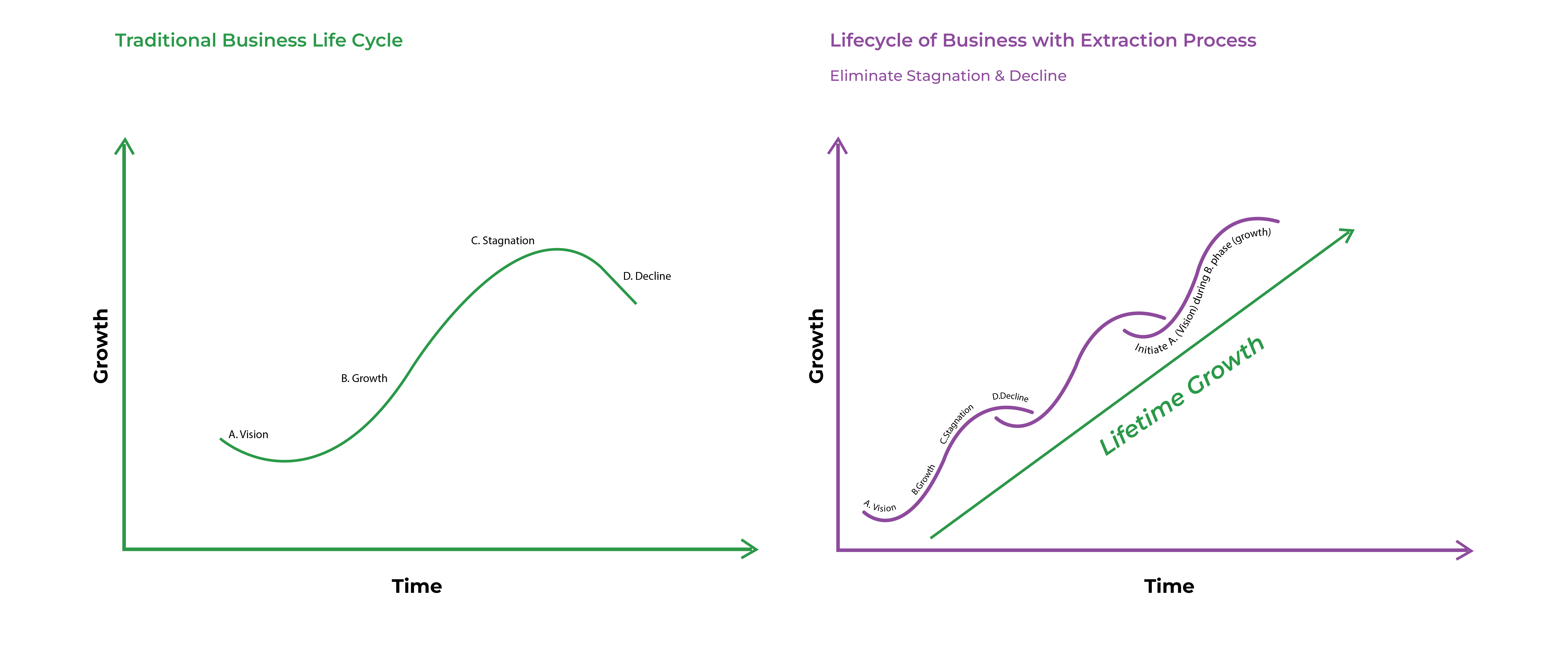
If you find that your dental practice has stagnated in any area: growth, teamwork, innovation, or even your own vision of what is possible, you will not be able to get out of that stagnation the same way you got into it.

“We cannot solve our problems with the same thinking we used when we created them.”

— Albert Einstein

How do you get out of that level of consciousness at the root of your current predicament? You must change your level of consciousness by uprooting the very ideas that created your current circumstances. As a leader, it takes tremendous courage to say, even to yourself, “Well, I got us into this. I must be the one to steer us out.”

Let me tell you a story. The following is an excerpt from my book, Extraction: The Surprising New Formula to Systemize, Scale and Sell Your Business.

Extraction for your Dental Practice

Within three months of owning my practice, and while working at two other practices as an associate, my office manager abruptly resigned from her position. I quickly realized that I had not just lost an office manager, but also our ability to bill and collect the money we earned. The administrative process for Medicaid claims is highly sensitive and tedious. It took months for me to be able to find, hire, and train a new office manager, during which time I felt like I was running out of oxygen and gasping for air to survive.

Cash for a business is like oxygen for the body. My cash flow was diminishing, and, at that time, I did not know how to accurately obtain data to diagnose the problem. Anxiety took over and I started having frequent panic attacks. Once again, my poverty mindset and my fear of overcoming destitution was at the forefront of my mind. I had finally opened my own practice with the opportunity to achieve the financial freedom I desired since I was a child.

And then overnight, this dream had quickly transformed to feel like a noose around my neck. I spent countless nights succumbing to the terror that I would not be able to live up to the many financial obligations that loomed over my head.

I realized that my only way out of my panic was to diagnose the problem, and to do that, I needed accurate data. Our practice was filled with manual charts and paper claims. I knew that I had to invest in digital systems so that I could gain control over the data which, in turn, would help me to diagnose and treat the cash flow disease of my practice accurately. At that moment, I was so grateful for the bank underwriter who had insisted that I get an additional working capital loan.

I invested in updating our practice management software and digitizing my whole practice. I also bargained with my cousin for IT and networking services in exchange for free lifetime dentistry. Eight months after my office manager had abandoned us, we finally started getting real data, and the truth was painful.

-Chapter 1: Choosing What Defines You, Extraction: The Surprising New Formula to Systemize, Scale and Sell Your Practice.

The Most Critical Lesson I Learned

I was in quite a pickle, but my stressed out mindset was not going to get my dental practice out of the situation it was in. I had to change my mindset; I had to change the actual operations in my practice in order for me to understand the data; and finally, I needed to ask for help.

These were not easy lessons or actions for me to take but they were necessary in order for me to understand my problem, diagnose it and then solve it. I had to change myself before I changed by business strategy.

How to Apply Point A to Your Dental Practice

Every meaningful journey starts with clarity about where you are today. Before you can set a compelling vision for your dental practice, you have to honestly assess your Point A: your current reality. Taking the time to step back and look at your practice from a higher vantage point creates awareness, perspective, and often, new solutions where obstacles once felt immovable.

Clarity comes from intention. It requires the right mindset, a clear look at your practice’s data, and a structured way to connect where you are today with where you want to go. That’s exactly why we created the Extraction GPS.

The Extraction GPS is a practical tool designed to help dental entrepreneurs clarify their values, define their current state, and map a clear path forward. It turns abstract ideas about vision and growth into something tangible you can work through, revisit, and use to guide decisions as your practice evolves.

At Optimize Practice Alliance, we believe the future of dentistry belongs with dentists and that future is built by leaders who take the time to define their direction with intention.

Ready to gain clarity on your Point A and chart a path forward?